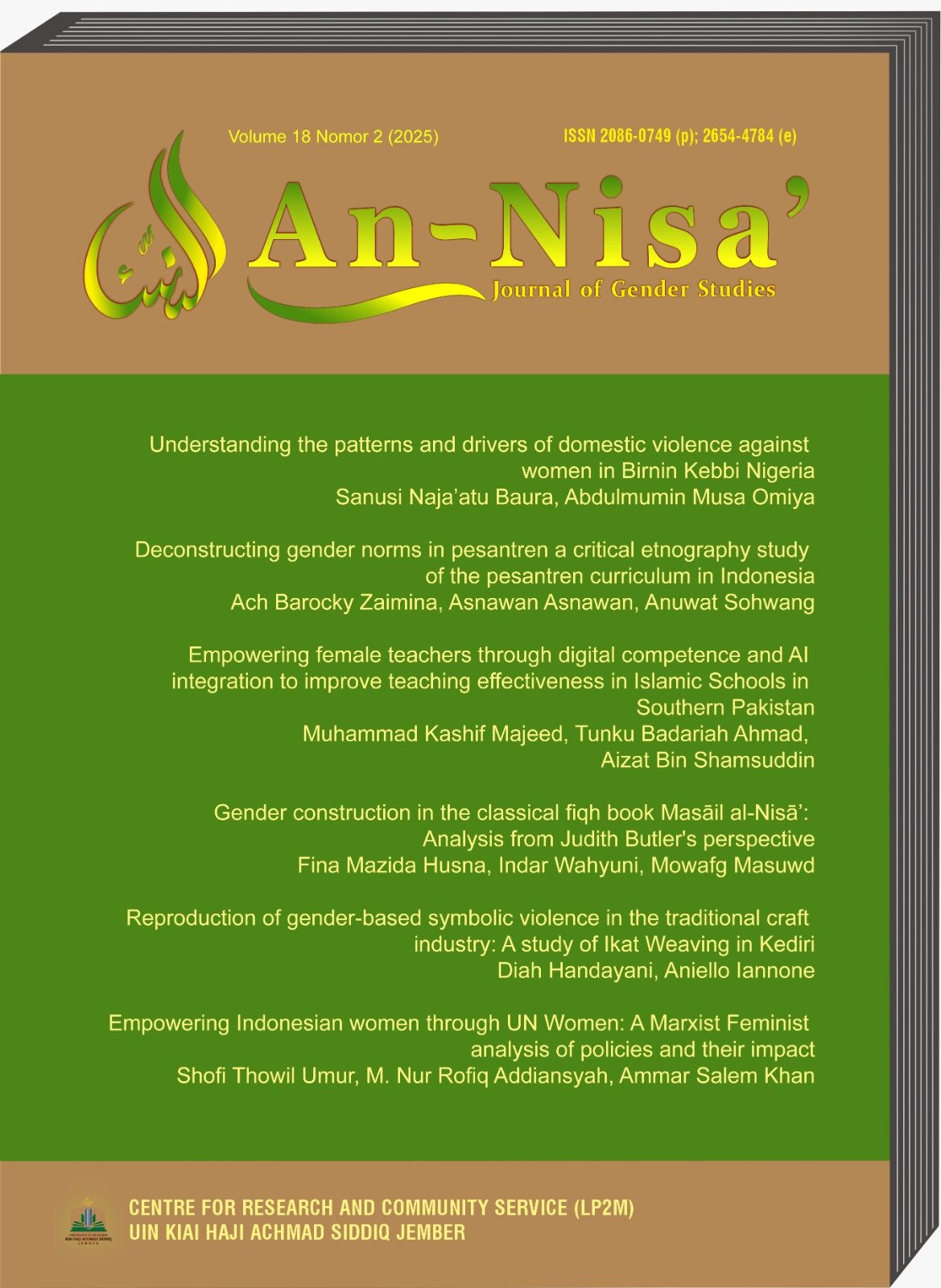
Empowering female teachers through digital competence and AI integration to improve teaching effectiveness in Islamic Schools in Southern Pakistan
DOI:
https://doi.org/10.35719/annisa.v18i2.395Keywords:
Woman Teacher, Islamic Schools, Digital Competencies, AI UsageAbstract
Female teachers in Islamic schools in Southern Punjab, Pakistan face unequal digital access, minimal Artificial Intelligence (AI) integration, and stark variations in digital competence. These conditions undermine teaching effectiveness and professional empowerment, with extreme regional disparities that cannot be ignored. This study analyzes regional differences in digital technology utilization, AI adoption, and informal digital learning, as well as how variations in access, digital competency, and institutional support influence teaching effectiveness among female teachers in Islamic secondary schools. Using a quantitative approach, the study examined the effects of digital competency, AI use, and informal digital learning on teaching effectiveness with 450 valid and reliable respondents, employing multiple regression analysis. The findings indicate that the empowerment of female teachers in Southern Pakistan varies across districts. First, female teachers’ contributions to instructional tasks differ regionally. Second, workload distribution and technology adoption also vary. Third, female teachers demonstrate strong digital competence and actively engage in informal learning; however, technology adoption is influenced by regional contexts. The study concludes that the empowerment of female teachers through digital competence and AI in Southern Pakistan is shaped by regional contexts. Variations in contributions across districts indicate a dependence on local ecosystems and adaptive capacity, rather than merely access to technology. This study contributes to highlighting the importance of institutional support, revealing structural inequalities, and emphasizing the role of informal learning over AI adoption in empowering female teachers.
References
Ahmed, S. K. (2024). How to choose a sampling technique and determine sample size for research: A simplified guide for researchers. Oral Oncology Reports, 12, 100662. https://doi.org/10.1016/j.oor.2024.100662
Alieto, E., Abequibel-Encarnacion, B., Estigoy, E., Balasa, K., Eijansantos, A., & Torres-Toukoumidis, A. (2024). Teaching inside a digital classroom: A quantitative analysis of attitude, technological competence and access among teachers across subject disciplines. Heliyon, 10(2), e24282. https://doi.org/10.1016/j.heliyon.2024.e24282
Aruleba, K., & Jere, N. (2022). Exploring digital transforming challenges in rural areas of South Africa through a systematic review of empirical studies. Scientific African, 16, e01190. https://doi.org/10.1016/j.sciaf.2022.e01190
Asare, B. (2025). Epistemological belief, reflective thinking and mathematics interest as a predictor of students’ mathematics performance: mediation analysis via structural equation modeling (SEM). Cogent Education, 12(1). https://doi.org/10.1080/2331186X.2025.2542437
Babirye, C., Muyoya, C., Mazumdar, S., Jimenez, A., Maina, C., Matogoro, J., … Kleine, D. (2022). Data science for empowerment: understanding the data science training landscape for women and girls in Africa. Gender, Technology and Development, 26(3), 437–462. https://doi.org/10.1080/09718524.2022.2137562
Bazen, A., Barg, F. K., & Takeshita, J. (2021). Research techniques made simple: An introduction to qualitative research. Journal of Investigative Dermatology, 141(2), 241–247.e1. https://doi.org/10.1016/j.jid.2020.11.029
Cardoso, F. C., Berri, R. A., Lucca, G., Borges, E. N., & Mattos, V. L. D. de. (2023). Testes de normalidade: estudo dos resíduos obtidos na modelagem da tendência de uma série temporal. Exacta, 23(1), 134–158. https://doi.org/10.5585/2023.22928
Cattaneo, A. A. P., Antonietti, C., & Rauseo, M. (2022). How digitalised are vocational teachers? Assessing digital competence in vocational education and looking at its underlying factors. Computers & Education, 176, 104358. https://doi.org/10.1016/j.compedu.2021.104358
Cattaneo, A. A. P., Antonietti, C., & Rauseo, M. (2025). How do vocational teachers use technology? The role of perceived digital competence and perceived usefulness in technology use across different teaching profiles. Vocations and Learning, 18(5). https://doi.org/10.1007/s12186-025-09359-4
Charania, A., Cross, S., Wolfenden, F., Sen, S., & Adinolfi, L. (2024). Exploring teacher characteristics and participation in TPACK-related online teacher professional development in Assam, India. Computers and Education Open, 7, 100227. https://doi.org/10.1016/j.caeo.2024.100227
Divanji, R. A., Bindman, S., Tung, A., Chen, K., Castaneda, L., & Scanlon, M. (2023). A one stop shop? Perspectives on the value of adaptive learning technologies in K-12 education. Computers and Education Open, 5, 100157. https://doi.org/10.1016/j.caeo.2023.100157
Dringo-Horvath, I., Rajki, Z., & T. Nagy, J. (2025). University Teachers’ Digital Competence and AI Literacy: Moderating Role of Gender, Age, Experience, and Discipline. Education Sciences, 15(7), 868. https://doi.org/10.3390/educsci15070868
Galindo-Domínguez, H., Delgado, N., Campo, L., & Losada, D. (2024). Relationship between teachers’ digital competence and attitudes towards artificial intelligence in education. International Journal of Educational Research, 126, 102381. https://doi.org/10.1016/j.ijer.2024.102381
Gandara, F., & Laesecke, A. (2022). Unpacking the relationship between female teachers and gender gaps in the Democratic Republic of the Congo: The critical role of gender-sensitive pedagogy in student attendance and achievement. Social Sciences & Humanities Open, 6(1), 100347. https://doi.org/10.1016/j.ssaho.2022.100347
Guan, L., Li, S., & Gu, M. M. (2024). AI in informal digital English learning: A meta-analysis of its effectiveness on proficiency, motivation, and self-regulation. Computers and Education: Artificial Intelligence, 7, 100323. https://doi.org/10.1016/j.caeai.2024.100323
Guillén-Gámez, F. D., Ruiz-Palmero, J., & García, M. G. (2023). Digital competence of teachers in the use of ICT for research work: Development of an instrument from a PLS-SEM approach. Education and Information Technologies, 28, 16509–16529. https://doi.org/10.1007/s10639-023-11895-2
Hennessy, S., D’Angelo, S., McIntyre, N., Koomar, S., Kreimeia, A., Cao, L., Brugha, M., & Zubairi, A. (2022). Technology use for teacher professional development in low- and middle-income countries: A systematic review. Computers and Education Open, 3, 100080. https://doi.org/10.1016/j.caeo.2022.100080
Heo, C. Y., Kim, B., Park, K., & Back, R. M. (2022). A comparison of best-worst scaling and Likert scale methods on peer-to-peer accommodation attributes. Journal of Business Research, 148, 368–377. https://doi.org/10.1016/j.jbusres.2022.04.064
Inayati, N., Sanjani, M. I., Jayanti, F. G., Gao, X. (Andy), & Nguyen, H. T. M. (2025). Online informal language learning (OILL): a systematic review of studies (2014–2023). Innovation in Language Learning and Teaching, 19(4), 335–351. https://doi.org/10.1080/17501229.2024.2355296
Instefjord, E. J., & Munthe, E. (2017). Educating digitally competent teachers: A study of integration of professional digital competence in teacher education. Teaching and Teacher Education, 67, 37–45. https://doi.org/10.1016/j.tate.2017.05.016
Katona, J., & Gyonyoru, K. I. K. (2025). Integrating AI-based adaptive learning into the flipped classroom model to enhance engagement and learning outcomes. Computers and Education: Artificial Intelligence, 8, 100392. https://doi.org/10.1016/j.caeai.2025.100392
Koehorst, M. M., van Deursen, A. J. A. M., van Dijk, J. A. G. M., & de Haan, J. (2021). A Systematic Literature Review of Organizational Factors Influencing 21st-Century Skills. Sage Open, 11(4). https://doi.org/10.1177/21582440211067251
Li, M. (2021). Uses and abuses of statistical control variables: Ruling out or creating alternative explanations? Journal of Business Research, 126, 472–488. https://doi.org/10.1016/j.jbusres.2020.12.037
Li, Y., & Xu, L. (2024). Exploring the influence of teachers’ motivation, self-efficacy, and institutional support on their research engagement: A study of Chinese university EFL teachers. System, 121, 103272. https://doi.org/10.1016/j.system.2024.103272
Luo, J., & Liu, X. (2025). What do we mean by digital equality in education? Toward five conceptual lenses based on a systematic review. Journal of Research on Technology in Education, 1–21. https://doi.org/10.1080/15391523.2025.2487279
Mårtensson, P., Fors, U., Wallin, S.-B., Zander, U., & Nilsson, G. H. (2016). Evaluating research: A multidisciplinary approach to assessing research practice and quality. Research Policy, 45(3), 593–603. https://doi.org/10.1016/j.respol.2015.11.009
Mayantao, R., & Tantiado, R. C. (2024). Teachers’ utilization of digital tools and confidence in technology. International Journal of Multidisciplinary Research and Analysis, 7(5). https://doi.org/10.47191/ijmra/v7-i05-16
Metwally, A. A., & Bin-Hady, W. R. A. (2025). Probing the necessity and advantages of AI integration training for EFL educators in Saudi Arabia. Cogent Education, 12(1). https://doi.org/10.1080/2331186X.2025.2472462
Morea, N. (2022). Investigating change in subjectivity: The analysis of Q-sorts in longitudinal research. Research Methods in Applied Linguistics, 1(3), 100025. https://doi.org/10.1016/j.rmal.2022.100025
Mustafa, F., Nguyen, H. T. M., & Gao, X. (2024). The challenges and solutions of technology integration in rural schools: A systematic literature review. International Journal of Educational Research, 126, 102380. https://doi.org/10.1016/j.ijer.2024.102380
Ning, Y., Zhang, C., Xu, B., Zhou, Y., & Wijaya, T. T. (2024). Teachers’ AI-TPACK: Exploring the relationship between knowledge elements. Sustainability, 16(3), 978. https://doi.org/10.3390/su16030978
Ragnedda, M., Ruiu, M. L., & Addeo, F. (2022). The self-reinforcing effect of digital and social exclusion: The inequality loop. Telematics and Informatics, 72, 101852. https://doi.org/10.1016/j.tele.2022.101852
Ratnasari, V., Audha, S. H., & Dani, A. T. R. (2023). Statistical modeling to analyze factors affecting the middle-income trap in Indonesia using panel data regression. MethodsX, 11, 102379. https://doi.org/10.1016/j.mex.2023.102379
Rehman, N., Huang, X., Mahmood, A., & colleagues. (2025). Assessing Pakistan’s readiness for STEM education: An analysis of teacher preparedness, policy frameworks, and resource availability. Humanities and Social Sciences Communications, 12, 1212. https://doi.org/10.1057/s41599-025-05584-3
Roorda, D. L., & Jak, S. (2024). Gender match in secondary education: The role of student gender and teacher gender in student–teacher relationships. Journal of School Psychology, 107, 101363. https://doi.org/10.1016/j.jsp.2024.101363
Rosyidah, S., Supriyanto, A., & Mustiningsih. (2025). Pengaruh Integrasi Teknologi dalam Pembelajaran Terhadap Kompetensi Pedagogi Digital Guru SMP. Kelola: Jurnal Manajemen Pendidikan, 12(1), 105–120. https://doi.org/10.24246/j.jk.2025.v12.i1.p105-120
Salih, S., Husain, O., Hamdan, M., Abdelsalam, S., Elshafie, H., & Motwakel, A. (2025). Transforming education with AI: A systematic review of ChatGPT's role in learning, academic practices, and institutional adoption. Results in Engineering, 25, 103837. https://doi.org/10.1016/j.rineng.2024.103837
Sánchez-Prieto, J., Trujillo Torres, J. M., Gómez García, M., & Gómez García, G. (2020). Gender and Digital Teaching Competence in Dual Vocational Education and Training. Education Sciences, 10(3), 84. https://doi.org/10.3390/educsci10030084
Tan, X., Cheng, G., & Ling, M. H. (2025). Artificial intelligence in teaching and teacher professional development: A systematic review. Computers and Education: Artificial Intelligence, 8, 100355. https://doi.org/10.1016/j.caeai.2024.100355
White, M. (2023). Sample size in quantitative instrument-based studies published in Scopus up to 2022: An artificial intelligence aided systematic review. Acta Psychologica, 241, 104095. https://doi.org/10.1016/j.actpsy.2023.104095
Zakharova, N., Frumina, S., Lobuteva, L., & Alwaely, S. (2024). The specifics of integrating distance learning technologies with traditional classroom instruction: How to design educational curricula in modern education? Heliyon, 10(20), e38740. https://doi.org/10.1016/j.heliyon.2024.e38740
Downloads
Published
Issue
Section
License
Copyright (c) 2025 Muhammad Kashif Majeed, Tunku Badariah Ahmad, Aizat Bin Shamsuddin

This work is licensed under a Creative Commons Attribution-NonCommercial 4.0 International License.
 AN-NISA licensed under Creative Commons Attribution-NonCommercial 4.0 International License.