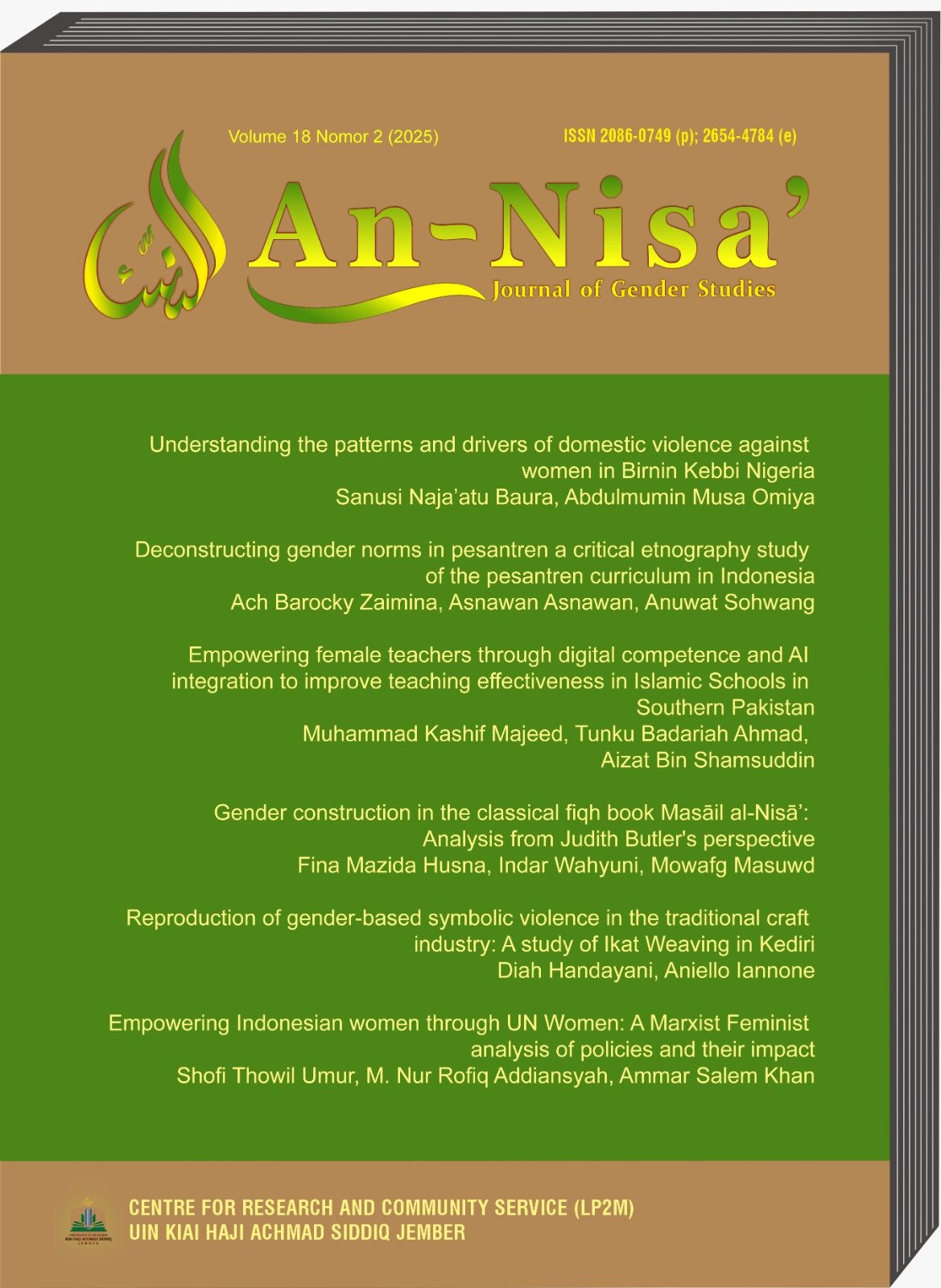
Reproduction of gender-based symbolic violence in the weaving industry: A case study of Ikat Weaving in Kediri
DOI:
https://doi.org/10.35719/annisa.v18i2.384Keywords:
Symbolic Violence, Gender, Habitus, Cultural FeminismAbstract
Gender-based symbolic violence in weaving industries is reproduced through informal work systems, wage disparities, and age hierarchies normalized by local culture, producing inequalities perceived as natural in informal labor contexts. This study aims to analyze symbolic violence in the Kediri ikat weaving industry across three domains working hours, wage structures, and age disparities that reproduce domination, inequality, and worker compliance. This study employed a qualitative approach using a case study design in three weaving centers in Kediri, involving 12 participants. Data were collected through interviews, observation, and documentation, and were analyzed thematically with triangulation for validation. This study identifies three forms of symbolic violence: (1) working-time exploitation through the putting-out system, subtle threats, rights removal, and dominant habitus; (2) wage inequality through gender-based differentiation, devaluation of women’s labor, and elimination of bonuses; and (3) age-based inequality through uniform wages, internalized resignation among elderly workers, and bonus allocation based on proximity to power structures. This study concludes that symbolic violence in working hours, wages, and age within the Kediri weaving industry is naturalized as normal practice, thereby sustaining structural inequalities that persist without resistance or critical awareness. This study contributes to the extension of Bourdieu’s theory by revealing the reproduction of symbolic violence in weaving labor, and offers practical implications in the form of wage transparency, recognition of skills equality, and fair bonus distribution.
References
Ahmed, S. K. (2024). The pillars of trustworthiness in qualitative research. Journal of Medicine, Surgery, and Public Health, 2, 100051. https://doi.org/10.1016/j.glmedi.2024.100051
Balkin, E. J., Kollerup, M. G., Kymre, I. G. G., Martinsen, B., & Grønkjær, M. (2023). Ethics and the impossibility of the consent form: Ethnography in a Danish nursing home. Journal of Aging Studies, 64, 101110. https://doi.org/10.1016/j.jaging.2023.101110
Bardall, G. (2019). Symbolic Violence as a Form of Violence Against Women in Politics: A Critical Examination. Revista Mexicana De Ciencias Políticas Y Sociales, 65(238). https://doi.org/10.22201/fcpys.2448492xe.2020.238.68152
Bourdieu, P. (1990). 3 Structures, Habitus, Practices. In The Logic of Practice (pp. 52-65). Stanford University Press. https://doi.org/10.1515/9781503621749-005
Bourdieu, P., & Thompson, J. B. (1991). Language and symbolic power (G. Raymond & M. Adamson, Trans.). Harvard University Press.
Braun, V., & Clarke, V. (2006). Using thematic analysis in psychology. Qualitative Research in Psychology, 3(2), 77–101. https://doi.org/10.1191/1478088706qp063oa
Cabral, Ó., Orduna, P., & Moreira, R. (2024). A participant observation methodology to analyse social functions, gender, class, and gastronomic practices in food-centric organizations: From the Gastronomic Societies in San Sebastián to the world. International Journal of Gastronomy and Food Science, 35, 100845. https://doi.org/10.1016/j.ijgfs.2023.100845
Carrasco-Santos, M. J., Seyfi, S., Hosseini, S., Hall, C. M., Mohajer, B., Almeida-García, F., & Cortes Macías, R. (2024). Breaking boundaries: Exploring gendered challenges and advancing equality for Iranian women careers in tourism. Tourism Management, 103, 104913. https://doi.org/10.1016/j.tourman.2024.104913
Chantamool, A., Suttisa, C., Gatewongsa, T., Jansaeng, A., Rawarin, N., & Daovisan, H. (2024). Promoting traditional ikat textiles: Ethnographic perspectives on indigenous knowledge, cultural heritage preservation and ethnic identity. Global Knowledge, Memory and Communication, 73(8–9), 1140–1158. https://doi.org/10.1108/GKMC-08-2022-0198
Contreras, G., Martínez-Martínez, M., Mateos de Cabo, R., Gimeno, R., & González Pérez, S. (2025). Navigating the networking myth: Women’s struggle for equity in corporate hierarchies. Gender in Management, 40(6), 775–794. https://doi.org/10.1108/GM-07-2024-0347
Dahwal, S., & Fernando, Z. J. (2024). The intersection of customary law and Islam: a case study of the Kelpeak Ukum Adat Ngen Ca’o Kutei Jang in the Rejang Tribe, Bengkulu Province, Indonesia. Cogent Social Sciences, 10(1). https://doi.org/10.1080/23311886.2024.2341684
Dias, R. M., Ogle, J. P., & Diddi, S. (2020). Constructing cultural identity through weaving among Ri-Bhoi women weavers: A symbolic interactionist approach. International Textile and Apparel Association Annual Conference Proceedings, 77(1). https://doi.org/10.31274/itaa.11989
Eger, C. (2021). Gender matters: Rethinking violence in tourism. Annals of Tourism Research, 88, 103143. https://doi.org/10.1016/j.annals.2021.103143
Franco-Torres, M., Kvålshaugen, R., & Ugarelli, R. M. (2021). Understanding the governance of urban water services from an institutional logics perspective. Utilities Policy, 68, 101159. https://doi.org/10.1016/j.jup.2020.101159
Friedemann, M. L., Mayorga, C., & Jimenez, L. D. (2011). Data collectors' field journals as tools for research. Journal of research in nursing: JRN, 16(5), 10.1177/1744987110387319. https://doi.org/10.1177/1744987110387319
Geekiyanage, D., Fernando, T., & Keraminiyage, K. (2021). Mapping Participatory Methods in the Urban Development Process: A Systematic Review and Case-Based Evidence Analysis. Sustainability, 13(16), 8992. https://doi.org/10.3390/su13168992
Graziano, R. (2025). Popular Habitus: Updating the Concept of “Habitus” as a Guide for the Selection of Cases of Analysis in Qualitative Digital Research. Societies, 15(6), 150. https://doi.org/10.3390/soc15060150
Guest, G., Bunce, A., & Johnson, L. (2006). How many interviews are enough? An experiment with data saturation and variability. Field Methods, 18(1), 59–82. https://doi.org/10.1177/1525822X05279903.
Han, Y., Fan, L. L., & Xue, Y. (2024). A sustainable balance between innovation and risk: How the “right to science” affects China’s medical biotechnology regulatory policy. Computational and Structural Biotechnology Journal, 24, 306–313. https://doi.org/10.1016/j.csbj.2024.04.027
Hayes, S., & Kleiner, B. H. (2001). The managed heart: The commercialisation of human feeling and its dangers. Management Research News, 24(3–4), 81–85. https://doi.org/10.1108/01409170110782667
Juran, L., & Trivedi, J. (2015). Women, Gender Norms, and Natural Disasters in Bangladesh. Geographical Review, 105(4), 601–611. https://doi.org/10.1111/j.1931-0846.2015.12089.x
Kabeer, N. (2010). Women's empowerment, development interventions and the management of information flows. IDS Bulletin, 41(1), 105–113. https://doi.org/10.1111/j.1759-5436.2010.00188.x
Krisnadi, T. (2024). The Role of Sumba Women Weavers in Family Economic Empowerment: A Case Study of Ikat Weaving Preservation in Sumba, NTT. Indonesian Interdisciplinary Journal of Sharia Economics (IIJSE), 8(1), 225-243. https://doi.org/10.31538/iijse.v8i1.5916
Li, Y. (2023). A study of empowerment and increased female exploitation of female workers in the textile industry. Advances in Applied Sociology, 13, 550–562. https://doi.org/10.4236/aasoci.2023.137034
Liang, B. (2024). Cultural sources of gender gaps: Confucian meritocracy reduces gender inequalities in political participation. Electoral Studies, 91, 102848. https://doi.org/10.1016/j.electstud.2024.102848
Mahmood, S. (2005). Politics of Piety: The Islamic Revival and the Feminist Subject (REV-Revised). Princeton University Press. https://doi.org/10.2307/j.ctvct00cf
McCarthy, F. (2024). (Mis)recognising the symbolic violence of academically selective education in England: A critical application of Bourdieusian analysis to pupils’ lived experiences. Critical Studies in Education, 66(5), 701–718. https://doi.org/10.1080/17508487.2024.2409672
Menéndez-Menéndez, M. I. (2014). Cultural industries and symbolic violence: Practices and discourses that perpetuate inequality. Procedia - Social and Behavioral Sciences, 161, 64–69. https://doi.org/10.1016/j.sbspro.2014.12.011
Morgenroth, T., & Ryan, M. K. (2018). Gender trouble in social psychology: How can Butler’s work inform experimental social psychologists’ conceptualization of gender? Frontiers in Psychology, 9, 1320. https://doi.org/10.3389/fpsyg.2018.01320
National Commission on Violence Against Women. (2024). Siaran pers gerak bersama dalam data: Laporan sinergi database kekerasan terhadap perempuan tahun 2023. Komisi Nasional Anti Kekerasan terhadap Perempuan. https://komnasperempuan.go.id/siaran-pers-detail/siaran-pers-gerak-bersama-dalam-data-laporan-sinergi-database-kekerasan-terhadap-perempuan-tahun-2023
Pickles, J. (2022). Gender: In world perspective (4th ed., R. Connell) [Book review]. Gender, Work & Organization, 29(2), 368–370. https://doi.org/10.1111/gwao.12738
Pollmann, A. (2021). Bourdieu and the Quest for Intercultural Transformations. Sage Open, 11(4). https://doi.org/10.1177/21582440211061391
Samuel, C. (2013). Symbolic Violence and Collective Identity: Pierre Bourdieu and the Ethics of Resistance. Social Movement Studies, 12(4), 397–413. https://doi.org/10.1080/14742837.2013.823345
Schlunegger, M. C., Zumstein-Shaha, M., & Palm, R. (2024). Methodologic and data-analysis triangulation in case studies: A scoping review. Western Journal of Nursing Research, 46(8), 611–622. https://doi.org/10.1177/01939459241263011
Schofield, J. (2021). Habitus and cultural capital. Fields: Journal of Huddersfield Student Research, 7(1). https://doi.org/10.5920/fields.814
Semuel, H., Mangoting, Y., & Hatane, S. E. (2022). The Interpretation of Quality in the Sustainability of Indonesian Traditional Weaving. Sustainability, 14(18), 11344. https://doi.org/10.3390/su141811344
Son Hing, L. S., Sakr, N., Sorenson, J. B., Stamarski, C. S., Caniera, K., & Colaco, C. (2023). Gender inequities in the workplace: A holistic review of organizational processes and practices. Human Resource Management Review, 33(3), 100968. https://doi.org/10.1016/j.hrmr.2023.100968
Stake, R. E. (1995). The art of case study research. Sage Publications.
Thapar-Bjorkert, S., Samelius, L., & Sanghera, G. S. (2016). Exploring symbolic violence in the everyday: Misrecognition, condescension, consent and complicity. Feminist Review, 112(1), 144–162. https://doi.org/10.1057/fr.2015.53
Tomaszewski, L. E., Zarestky, J., & Gonzalez, E. (2020). Planning qualitative research: Design and decision making for new researchers. International journal of qualitative methods, 19, https://doi.org/10.1177/1609406920967174
Tong, R. (2018). Feminist Thought: A More Comprehensive Introduction (5th ed.). Routledge. https://doi.org/10.4324/9780429495243
Uekusa, S., Nguyen-Trung, K., Lorenz, D. F., Michael, S., & Karki, J. (2024). Bourdieu and early career researchers (ECRs) in disaster research: A collaborative autoethnography (CAE). International Journal of Disaster Risk Reduction, 114, 104969. https://doi.org/10.1016/j.ijdrr.2024.104969
Uwen, G. O., & Ukam, E. I. (2024). This Is the Sacrifice: Language, Ideology and Religious Identity Performance in Erei Personal Names. Languages, 9(10), 326. https://doi.org/10.3390/languages9100326
Varriale, S. (2015). Cultural production and the morality of markets: Popular music critics and the conversion of economic power into symbolic capital. Poetics, 51, 1–16. https://doi.org/10.1016/j.poetic.2015.03.002
Vogel, M., Kacperski, C., Bielig, M., & Kutzner, F. (2024). Doing gender in energy communities: A gendered perspective on barriers and motivators. Environmental Innovation and Societal Transitions, 53, 100902. https://doi.org/10.1016/j.eist.2024.100902
Vogeley, J., & Oetojo, J. O. (2025). “She Understands the Weaving Dance:” Textiles, Values, and Profitability. Business & Society, 64(8), 1486-1519. https://doi.org/10.1177/00076503251338740
Widiastuti, T., Al-shami, S. A., Mawardi, I., Zulaikha, S., Haron, R., Kasri, R. A., Al Mustofa, M. U., & Dewi, E. P. (2024). Capturing the barriers and strategic solutions for women empowerment: Delphi analytical network process. Journal of Open Innovation: Technology, Market, and Complexity, 10(3), 100345. https://doi.org/10.1016/j.joitmc.2024.100345
Zhong, Y., Tang, S., & Lan, M. (2023). Research on the Inheritance Path and the Branding Inheritance Model of Traditional Crafts. Sustainability, 15(7), 5878. https://doi.org/10.3390/su15075878
Zhu, J., Spence, C., & Ezzamel, M. (2021). Thinking like the state: Doxa and symbolic power in the accounting field in China. Accounting, Organizations and Society, 93, 101235. https://doi.org/10.1016/j.aos.2021.101235
Downloads
Published
Issue
Section
License
Copyright (c) 2025 Diah Handayani, Aniello Iannone

This work is licensed under a Creative Commons Attribution-NonCommercial 4.0 International License.
 AN-NISA licensed under Creative Commons Attribution-NonCommercial 4.0 International License.