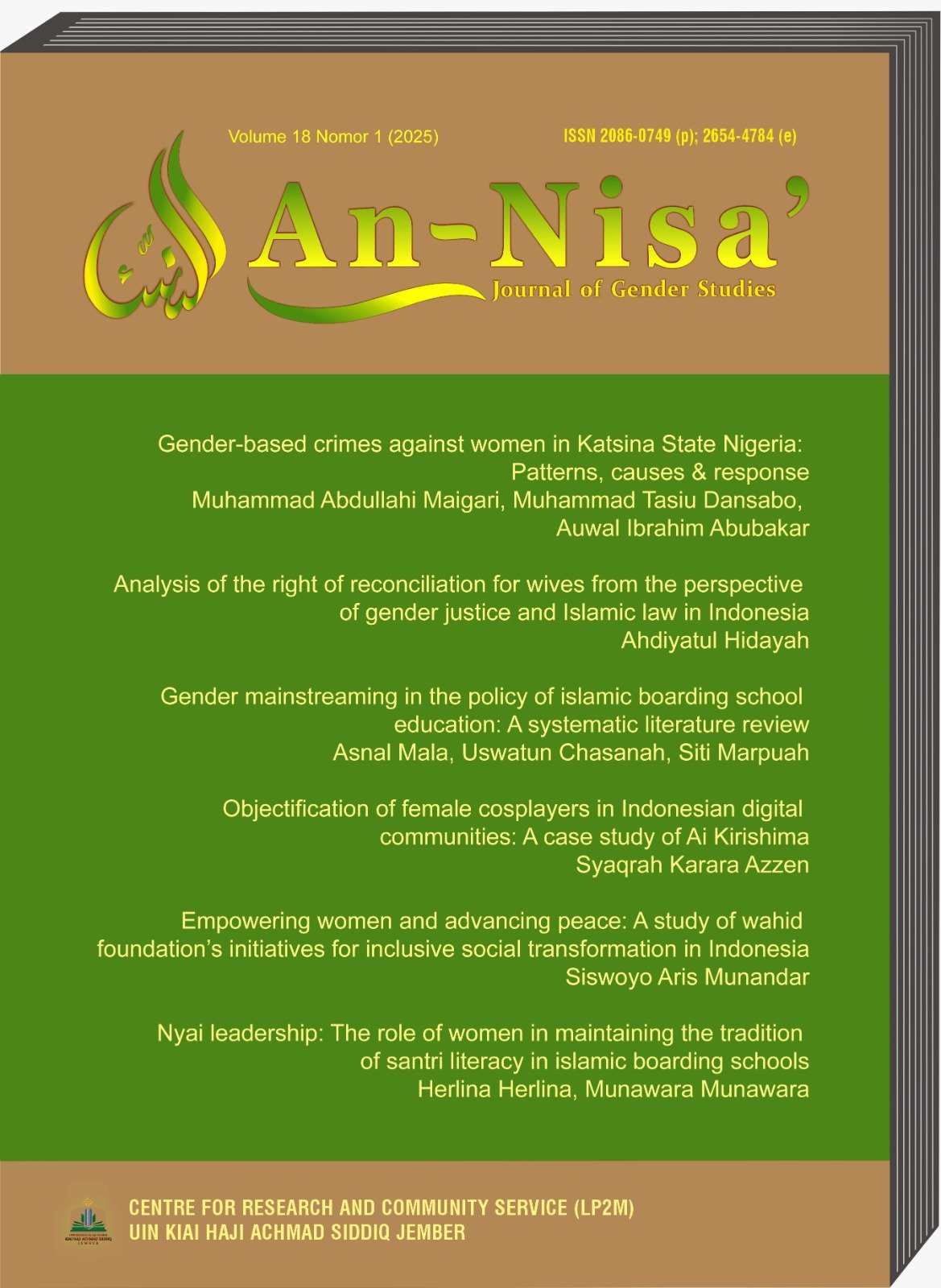
Nyai leadership: The role of women in maintaining the tradition of santri literacy in islamic boarding schools
DOI:
https://doi.org/10.35719/annisa.v18i1.319Keywords:
Leadership of Nyai, Literacy tradition, Boarding School of Pesantren, WomenAbstract
Islamic boarding schools (pesantren) have a strong literacy tradition, yet female leaders’ roles in sustaining it are often overlooked. Recognizing their visionary, participatory leadership is essential to understanding how they foster student motivation, literacy practices, and integration of cultural, institutional, and pedagogical dimensions. This study aims to analyze the leadership role of Nyai (wife of the Kiai) in sustaining and developing the literacy culture of santri in pesantren through leadership transformation, the strengthening of literacy institutions, and the establishment of a santri literacy ecosystem. A qualitative phenomenological approach was employed, with data collected through in-depth interviews, participant observation, and document analysis. The data were analyzed thematically using triangulation of sources, methods, and time to ensure credibility, capture participants’ subjective experiences, and connect the findings with theories of women’s leadership. The study finds three key points. First, the Nyai's leadership transformed into competence-based institutional authority via mandatory reading programs and restructuring. Second, literacy reinforcement combined regulations with non-formal policies, expanding academic spaces and santri participation. Third, literacy success relied on synergy among visionary leadership, santri motivation, spiritual climate, institutional support, and trust in santri to manage literacy. The study concludes that Nyai's leadership transforms from domestic companion to competence-based institutional authority, synergizing visionary leadership, student motivation, and trust to make literacy an institutionalized and regenerated intellectual heritage. This study contributes to enriching transformational leadership and institutional work models, offering a practical literacy empowerment model for Islamic schools.
References
Acker, J. (1990). Hierarchies, jobs, bodies: A theory of gendered organizations. Gender & Society, 4(2), 139–158. https://doi.org/10.1177/089124390004002002
Acosta-Gonzaga, E., & Ramirez-Arellano, A. (2022). Scaffolding matters? Investigating its role in motivation, engagement and learning achievements in higher education. Sustainability, 14(20), 13419. https://doi.org/10.3390/su142013419
Aini, N. K., Nasir, M. R., & Hilmy, M. (2021). Transformational leadership of Nyai – case study in Roudlotun Nasyiin Islamic boarding school. Journal of Women's Entrepreneurship and Education, 1–2, 164–173. https://doi.org/10.28934/jwee21.12.pp164-173
Anderson-Levitt, K. (2021). 21st century skills in the United States: A late, partial and silent reform. Comparative Education, 57(1), 99–114. https://doi.org/10.1080/03050068.2020.1845059
Aquino, K., McFerran, B., & Laven, M. (2011). Moral identity and the experience of moral elevation in response to acts of uncommon goodness. Journal of Personality and Social Psychology, 100(4), 703–718. https://doi.org/10.1037/a0022540
Arroyo, Y. P. V., Peñabaena-Niebles, R., & Berdugo Correa, C. (2023). Influence of environmental conditions on students' learning processes: A systematic review. Building and Environment, 231, 110051. https://doi.org/10.1016/j.buildenv.2023.110051
Bakker, A. B., Hetland, J., Olsen, O. K., & Espevik, R. (2023). Daily transformational leadership: A source of inspiration for follower performance? European Management Journal, 41(5), 700–708. https://doi.org/10.1016/j.emj.2022.04.004
Bass, B. M. (1999). Two decades of research and development in transformational leadership. European Journal of Work and Organizational Psychology, 8(1), 9–32. https://doi.org/10.1080/135943299398410
Bass, B.M., & Riggio, R.E. (2006). Transformational Leadership (2nd ed.). Psychology Press. https://doi.org/10.4324/9781410617095
Bingham, A. J. (2023). From Data Management to Actionable Findings: A Five-Phase Process of Qualitative Data Analysis. International Journal of Qualitative Methods, 22. https://doi.org/10.1177/16094069231183620
Boyatzis, R., & Boyatzis, R. E. (2008). Competencies in the 21st century. Journal of Management Development, 27(1), 5–12. https://doi.org/10.1108/02621710810840730
Carter, N., Bryant-Lukosius, D., DiCenso, A., Blythe, J., & Neville, A. J. (2014). The Use Of Triangulation In Qualitative Research. Oncology nursing forum, 41(5), 545–547. https://doi.org/10.1188/14.ONF.545-547
Chapman, M. (2018). Modesty, liberty, equality: Negotiations of gendered principles of piety among Muslim women who cover. Feminism & Psychology, 28(4), 509-529. https://doi.org/10.1177/0959353518789714
Cochrane, L., Ozturk, O., Khataee, H., Al-Hababi, R., Al-Malki, F., & Nourin, H. (2022). Fostering a reading culture: Evidence from Qatar Reads. Development Studies Research, 9(1), 82–94. https://doi.org/10.1080/21665095.2022.2050774
Coleman, J. S. (1988). Social capital in the creation of human capital. American Journal of Sociology, 94(Supplement), S95–S120. https://doi.org/10.1086/228943
Collins, C. S., & Stockton, C. M. (2018). The Central Role of Theory in Qualitative Research. International Journal of Qualitative Methods, 17(1). https://doi.org/10.1177/1609406918797475
Davies, D., Jindal-Snape, D., Collier, C., Digby, R., Hay, P., & Howe, A. (2013). Creative learning environments in education—A systematic literature review. Thinking Skills and Creativity, 8, 80–91. https://doi.org/10.1016/j.tsc.2012.07.004
Dodgson, J. E. (2023). Phenomenology: Researching the lived experience. Journal of Human Lactation, 39(3), 385–396. https://doi.org/10.1177/08903344231176453
Donkoh, S., & Mensah, J. (2023). Application of triangulation in qualitative research. Journal of Applied Biotechnology & Bioengineering, 10(1), 6–9. https://doi.org/10.15406/jabb.2023.10.00319
Englander, M. (2016). The phenomenological method in qualitative psychology and psychiatry. International Journal of Qualitative Studies on Health and Well-Being, 11(1). https://doi.org/10.3402/qhw.v11.30682
Esmeli, R., Bader-El-Den, M., & Abdullahi, H. (2022). An analysis of the effect of using contextual and loyalty features on early purchase prediction of shoppers in e-commerce domain. Journal of Business Research, 147, 420–434. https://doi.org/10.1016/j.jbusres.2022.04.012
Fatmawati, F., Amir, R., Alamsyah, A., & Ilham, M. (2024). Transformation of women’s leadership in pesantren from Fiqh Siyāsah perspective: Social dynamics in the patriarchal culture of South Sulawesi. Samarah: Jurnal Hukum Keluarga dan Hukum Islam, 8(3), 1800–1817. https://doi.org/10.22373/sjhk.v8i3.18647
Fatmawati, F., Amir, R., Alamsyah, A., & Rahmawati, R. (2024). Solutions to patriarchal challenges: Women’s leadership in Islamic boarding schools and the role of Bissu figures in South Sulawesi. International Journal of Religion, 5(11), 7458–7466. https://doi.org/10.61707/4hzfnw64
Flechtner, S., Lich, U., & Pelz, S. (2024). Women’s decision-making power, cooking fuel adoption and appliance ownership: Evidence from Rwanda, Nepal and Honduras. Energy Research & Social Science, 118, 103780. https://doi.org/10.1016/j.erss.2024.103780
Frechette, J., Bitzas, V., Aubry, M., Kilpatrick, K., & Lavoie-Tremblay, M. (2020). Capturing lived experience: Methodological considerations for interpretive phenomenological inquiry. International Journal of Qualitative Methods, 19. https://doi.org/10.1177/1609406920907254
Galsanjigmed, E., & Sekiguchi, T. (2023). Challenges women experience in leadership careers: An integrative review. Merits, 3(2), 366–389. https://doi.org/10.3390/merits3020021
Garud, R., Hardy, C., & Maguire, S. (2007). Institutional entrepreneurship as embedded agency: An introduction to the special issue. Organization Studies, 28(7), 957-969. https://doi.org/10.1177/0170840607078958
Guo, D., Ramos, R. L. M., & Wang, F. (2024). Qualitative online interviews: Voices of applied linguistics researchers. Research Methods in Applied Linguistics, 3(3), 100130. https://doi.org/10.1016/j.rmal.2024.100130
Hadianto, D., Damaianti, V. S., Mulyati, Y., & Sastromiharjo, A. (2022). Effectiveness of literacy teaching design integrating local culture discourse and activities to enhance reading skills. Cogent Education, 9(1), 2016040. https://doi.org/10.1080/2331186X.2021.2016040
Hanafi, Y., Taufiq, A., Saefi, M., Ikhsan, M. A., Diyana, T. N., Thoriquttyas, T., & Anam, F. K. (2021). The new identity of Indonesian Islamic boarding schools in the “new normal”: The education leadership response to COVID-19. Heliyon, 7(3), e06549. https://doi.org/10.1016/j.heliyon.2021.e06549
Hassan, K. S., & Wright, E. (2023). Gender and leadership: Student perspectives on gender stereotypes in round square schools. ECNU Review of Education, 0(0). https://doi.org/10.1177/20965311231210010
Hilal, Y. Y., Mifsud, D., & Hammad, W. (2024). Female educational leadership in the Arab world: A systematic review of published research literature. International Journal of Leadership in Education, 1–29. https://doi.org/10.1080/13603124.2024.2316655
Hojeij, Z. (2024). Educational leadership's role in fostering innovation and entrepreneurship in education: A narrative literature review. Social Sciences & Humanities Open, 10, 101173. https://doi.org/10.1016/j.ssaho.2024.101173
Jakobsen, M. (2014). Book review: W. Richard Scott, Institutions and organizations: Ideas, interests, and identities. Canadian Journal of Administrative Sciences, 32(2). https://doi.org/10.22439/cjas.v32i2.4764
Johnson, T. P. (2014). Snowball sampling: Introduction. In Wiley StatsRef: Statistics Reference Online (eds N. Balakrishnan, T. Colton, B. Everitt, W. Piegorsch, F. Ruggeri and J.L. Teugels). https://doi.org/10.1002/9781118445112.stat05720
Konstantinidis, A. (2024). An integrative review of the literature on factors influencing student well-being in the learning environment. International Journal of Educational Research Open, 7, 100384. https://doi.org/10.1016/j.ijedro.2024.100384
Lawrence, T., & Suddaby, R. (2006). Institutions and institutional work. In S. R. Clegg, C. Hardy, W. R. Nord, & T. Lawrence (Eds.), The SAGE handbook of organization studies (pp. 215–254). Sage. https://doi.org/10.4135/9781848608030.n7
Levy, R. (2016). A historical reflection on literacy, gender and opportunity: Implications for the teaching of literacy in early childhood education. International Journal of Early Years Education, 24(3), 279–293. https://doi.org/10.1080/09669760.2016.1165652
Lim, W. M. (2024). What Is Qualitative Research? An Overview and Guidelines. Australasian Marketing Journal, 33(2), 199-229. https://doi.org/10.1177/14413582241264619
Marmoah, S., Indrastoeti, J., Poerwanti, S., & Suharno. (2022). Literacy culture management of elementary school in Indonesia. Heliyon, 8(4), e09315. https://doi.org/10.1016/j.heliyon.2022.e09315
McGrath, C., Palmgren, P. J., & Liljedahl, M. (2018). Twelve tips for conducting qualitative research interviews. Medical Teacher, 41(9), 1002–1006. https://doi.org/10.1080/0142159X.2018.1497149
Merino, M., Tornero-Aguilera, J. F., Rubio-Zarapuz, A., Villanueva-Tobaldo, C. V., Martín-Rodríguez, A., & Clemente-Suárez, V. J. (2024). Body perceptions and psychological well-being: A review of the impact of social media and physical measurements on self-esteem and mental health with a focus on body image satisfaction and its relationship with cultural and gender factors. Healthcare, 12(14), 1396. https://doi.org/10.3390/healthcare12141396
Muna, N., & Hamam, H. (2020). Kepemimpinan Nyai di Pesantren Al Hajar Kapurejo Pagu Kediri. Intelektual: Jurnal Pendidikan dan Studi Keislaman, 10(1), 46–57. https://doi.org/10.33367/ji.v10i1.1090
Munna, A. S. (2021). Instructional leadership and role of module leaders. International Journal of Educational Reform, 32(1), 38-54. https://doi.org/10.1177/10567879211042321
Murray, P. (2003). Organisational learning, competencies, and firm performance: Empirical observations. The Learning Organization, 10(5), 305–316. https://doi.org/10.1108/09696470310486656
Mustofa, M., Marijan, K., Romadhoni, M., & Setiawan, B. (2023). How to deal and negotiate with the campus environment? Female students’ experiences in reconstructing gender identity. Journal of Ethnic and Cultural Studies, 10(3), 18–34. https://doi.org/10.29333/ejecs/1618
Naeem, M., Ozuem, W., Howell, K., & Ranfagni, S. (2023). A step-by-step process of thematic analysis to develop a conceptual model in qualitative research. International Journal of Qualitative Methods, 22. https://doi.org/10.1177/16094069231205789
Nolan, A., & Molla, T. (2017). Teacher confidence and professional capital. Teaching and Teacher Education, 62, 10–18. https://doi.org/10.1016/j.tate.2016.11.004
Palinkas, L. A., Horwitz, S. M., Green, C. A., Wisdom, J. P., Duan, N., & Hoagwood, K. (2015). Purposeful sampling for qualitative data collection and analysis in mixed method implementation research. Administration And Policy In Mental Health, 42(5), 533–544. https://doi.org/10.1007/s10488-013-0528-y
Ragnarsson, S., Kristjánsdóttir, E. S., & Gunnarsdóttir, S. (2018). To be accountable while showing care: The lived experience of people in a servant leadership organization. SAGE Open, 8(3). https://doi.org/10.1177/2158244018801097
Rahman, B. (2022). Islamic revival and cultural diversity: Pesantren’s configuration in contemporary Aceh Indonesia. Indonesian Journal of Islam and Muslim Societies, 12(1), 201-229. https://doi.org/10.18326/ijims.v12i1.201-229
Reed, E., & Johnson, B. (2023). Overview of cultural capital theory's current impact and potential utility in academic libraries. The Journal of Academic Librarianship, 49(6), 102782. https://doi.org/10.1016/j.acalib.2023.102782
Reza, V., Ardiansyah, M. F., Khovivah, S. N., Camila, L. A., Islam, U., Siber, N., Nurjati, S., & Community, A. (2024). Implikasi budaya patriarki terhadap perubahan peran perempuan dalam keluarga di lingkungan sivitas akademik. JSPH: Jurnal Sosial Politik Humaniora, 1(3), 30–41. https://doi.org/10.59966/jsph.v1i3.1427
Riggio, R. E., & Bass, B. M. (2005). Transformational leadership. Lawrence Erlbaum Associates. https://doi.org/10.4324/9781410617095
Roaldsnes, A. (2024). Social capital and the intergenerational transmission of cultural capital: How parents’ social networks influence children's accumulation of cultural capital. Poetics, 102, 101873. https://doi.org/10.1016/j.poetic.2024.101873
Rusticus, S. A., Pashootan, T., & Mah, A. (2023). What are the key elements of a positive learning environment? Perspectives from students and faculty. Learning environments research, 26(1), 161–175. https://doi.org/10.1007/s10984-022-09410-4
Rutledge, P. B., & Hogg, J. L. C. (2020). In-depth interviews. In J. Bulck (Ed.), The International encyclopedia of media psychology. https://doi.org/10.1002/9781119011071.iemp0019
Sari, G. I., Winasis, S., Pratiwi, I., Nuryanto, U. W., & Basrowi. (2024). Strengthening digital literacy in Indonesia: Collaboration, innovation, and sustainability education. Social Sciences & Humanities Open, 10, 101100. https://doi.org/10.1016/j.ssaho.2024.101100
Schmitz, M.-L., Antonietti, C., Consoli, T., Cattaneo, A., Gonon, P., & Petko, D. (2023). Transformational leadership for technology integration in schools: Empowering teachers to use technology in a more demanding way. Computers & Education, 204, 104880. https://doi.org/10.1016/j.compedu.2023.104880
Siddiqui, S. A., Singh, S., Bahmid, N. A., & Sasidharan, A. (2024). Applying innovative technological interventions in the preservation and packaging of fresh seafood products to minimize spoilage: A systematic review and meta-analysis. Heliyon, 10(8), e29066. https://doi.org/10.1016/j.heliyon.2024.e29066
Singh, A., Das, S., & Jha, S. (2023). Women leadership and emotions: Knowledge structure and future research opportunities. European Management Journal, 41(6), 864–882. https://doi.org/10.1016/j.emj.2023.05.004
Sumanti, S. T., Salminawati, Budianti, Y., Wibowo, B. S., Syarif, J., Hamidah, D., & Usman, J. (2024). Development of the study of Islamic education in Scopus-indexed international publications in 2017–2022: Bibliometric analysis. Educational Administration: Theory and Practice, 30(6), 3494–3499. https://doi.org/10.53555/kuey.v30i6.1005
Valencia, M. M. A. (2022). Principles, scope, and limitations of the methodological triangulation. Investigacion Y Educacion En Enfermeria, 40(2), e03. https://doi.org/10.17533/udea.iee.v40n2e03
Zamiri, M., & Esmaeili, A. (2024). Methods and technologies for supporting knowledge sharing within learning communities: A systematic literature review. Administrative Sciences, 14(1), 17. https://doi.org/10.3390/admsci14010017
Zaqiah, Q. Y., Hasanah, A., Heryati, Y., & Rohmatulloh, R. (2024). The impact of in-service teacher education program on competency improvement among Islamic religious education teachers using self-assessment. Education Sciences, 14(11), 1257. https://doi.org/10.3390/educsci14111257
Downloads
Published
Issue
Section
License
Copyright (c) 2025 Herlina Herlina, Munawara Munawara, Irmak Sude Gurel

This work is licensed under a Creative Commons Attribution-NonCommercial 4.0 International License.
 AN-NISA licensed under Creative Commons Attribution-NonCommercial 4.0 International License.