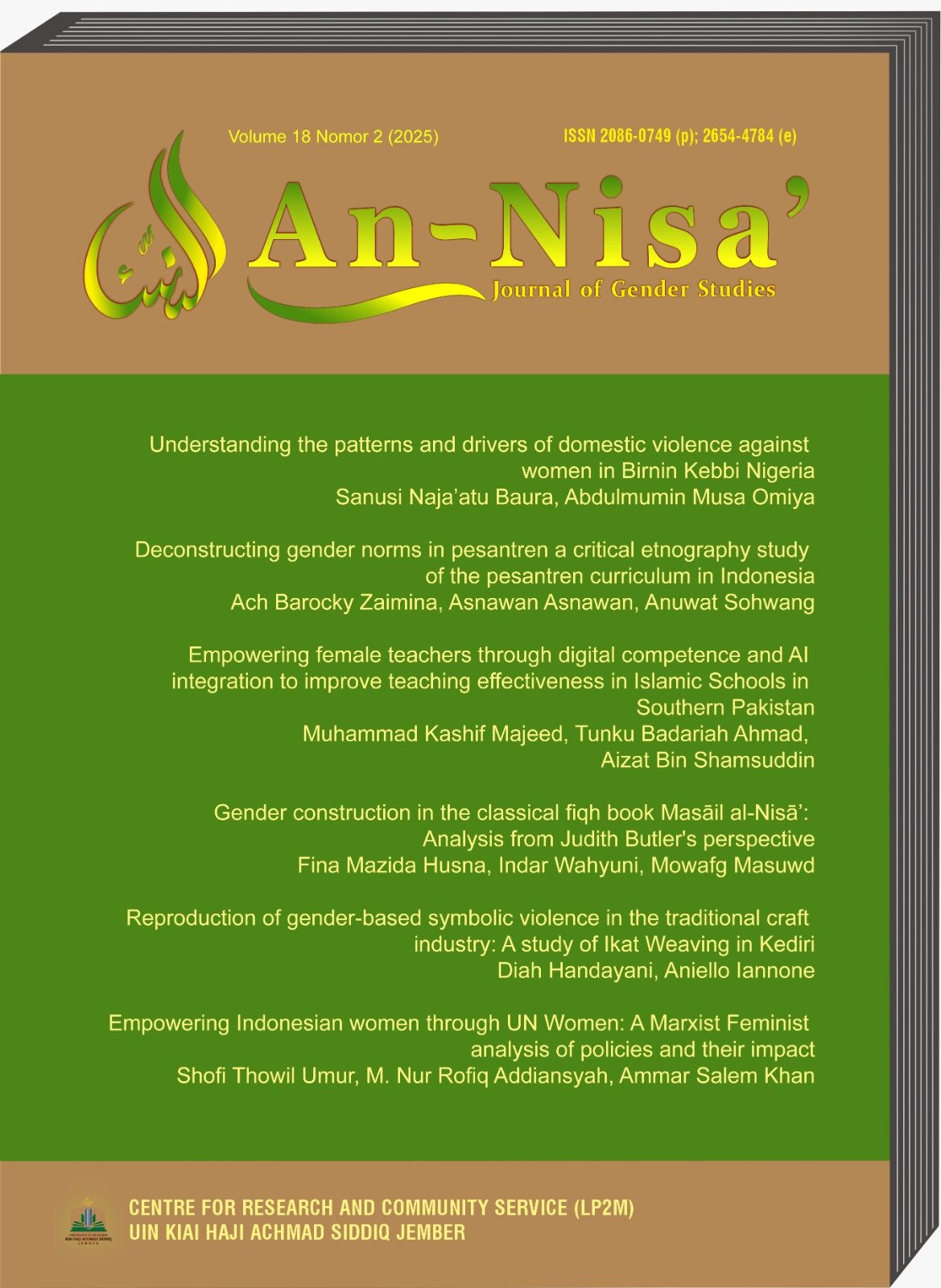
Gender construction in the classical fiqh book Masāil al-Nisā’: Analysis from Judith Butler's perspective
DOI:
https://doi.org/10.35719/annisa.v18i2.315Keywords:
Gender, Judith Butler, Masāilun al-Nisa’, Performatif, WomanAbstract
A major issue in classical fiqh is gender representation, where women are often positioned subordinate to men. Masāil al-Nisā’ constructs female identities and domestic roles through the repetition of socio-religious norms. This study analyzes the construction of gender in Masāil al-Nisā’ using the performativity theory of Judith Butler. It reveals how fiqh legitimizes binary norms, naturalizes masculine authority, and religiously reproduces women’s subordination within domestic and marital hierarchies. Employing a descriptive qualitative-interpretative approach, thematic analysis, and Butler’s gender performativity theory, the research analyzes primary texts and supporting literature to uncover constructions of women’s roles, identities, and subordination in domestic contexts. The study on Masāil al-Nisāʾ finds that women’s access to the public sphere is conditional and necessity-based with unclear moral regulation. Textual prohibitions against imitating the opposite sex reinforce binary gender divisions. Women are positioned as inherently domestic supporters of husbands or fathers with limited public roles. Although balance is emphasized, male authority in final decisions results in concealed gender subordination. This study concludes that Masāil al-Nisāʾ constructs a normative and hierarchical gender framework, conditionally granting women public space while consistently positioning men as the primary authority, thereby producing covert subordination in gender relations based on religious legitimacy. This study enriches Islamic gender studies, critiques the concept of women's nature (kodrat), state ibuism, and promotes critical reading of fiqh texts.
References
Abdurrohim, N., & Ali, H. (2019). Kontekstualiasi kedudukan dan peran perempuan dalam kitab taqrib. Jurnal Perspektif, 3(1), 57–74. https://doi.org/10.15575/jp.v3i1.35
Abou El Fadl, K. (2017). Qurʾanic ethics and Islamic law. Journal of Islamic Ethics, 1(1–2), 7–28. https://doi.org/10.1163/24685542-12340002
Ahmad, N., Zamri, Z., & Omarali, N. (2024). Islamic nations' approaches to combating gender discrimination against women: An examination of the Southeast Asia region. De Jure: Jurnal Hukum dan Syar'iah, 16(2), 501-530. https://doi.org/10.18860/j-fsh.v16i2.29965
Ahmed, S. K., Mohammed, R. A., Nashwan, A. J., Ibrahim, R. H., Abdalla, A. Q., Ameen, B. M. M., & Khdhir, R. M. (2025). Using thematic analysis in qualitative research. Journal of Medicine, Surgery, and Public Health, 6, 100198. https://doi.org/10.1016/j.glmedi.2025.100198
Ansor, M. (2016). Post-Islamism and the remaking of islamic public sphere in post-reform Indonesia. Studia Islamika, 23(3), 471–515. https://doi.org/10.15408/sdi.v23i3.2412
Aulia, S. S., Marzuki, S., Suyato, & Arpannudin, I. (2024). Women in gender equality movement: A systematic literature review. Frontiers in Sociology, 9, 1432383. https://doi.org/10.3389/fsoc.2024.1432383
Bellani, L., & Hidalgo-Hidalgo, M. (2025). Bridging the gender gap: Women’s education and political representation. Economics of Education Review, 104, 102605. https://doi.org/10.1016/j.econedurev.2024.102605
Bingham, A. J. (2023). From data management to actionable findings: A five-phase process of qualitative data analysis. International Journal of Qualitative Methods, 22. https://doi.org/10.1177/16094069231183620
Braun, V., & Clarke, V. (2006). Using thematic analysis in psychology. Qualitative Research in Psychology, 3(2), 77–101. https://doi.org/10.1191/1478088706qp063oa
Butler, J. (1988). Performative acts and gender constitution: An essay in phenomenology and feminist theory. Theatre Journal, 40(4), 519–531. https://doi.org/10.2307/3207893
Butler, J. (1990). Gender trouble: Feminism and the subversion of identity. Routledge. https://selforganizedseminar.wordpress.com/wp-content/uploads/2011/07/butler-gender_trouble.pdf
Butler, J. (2011). Bodies that matter: On the discursive limits of sex (1st ed.). Routledge. https://doi.org/10.4324/9780203828274
Dawood, S. (2024). Islamic law and gender equality: challenges and reforms in Sri Lanka’s muslim marriage and divorce act. Journal of Islamic Law, 5(2), 288–305. https://doi.org/10.24260/jil.v5i2.2833
Dewi, K. H. (2016). Demokratisasi dan dekonstruksi ideologi gender orde baru. Jurnal Penelitian Politik, 4(1), 59–68. https://doi.org/10.14203/jpp.v4i1.450
Fakhyadi, D., Samsudin, M. A., Dasrianto, V., Danil, M., & Wahyudi, A. A. (2025). Reconstructing gender relations for family resilience in Minangkabau: Integrating Islamic law and customary law. Al-Ahkam, 35(1), 1–30. https://doi.org/10.21580/ahkam.2025.35.1.22906
Gojali, D., Abdurrohim, N., & Ali, H. (2020). The representation of women’s role and position in Taqrib Book: A discourse analysis study. Mazahib, 19(1), 135-160. https://doi.org/10.21093/mj.v19i1.1737
Gouda, M., & Potrafke, N. (2016). Gender equality in muslim-majority countries. Economic Systems, 40(4), 683–698. https://doi.org/10.1016/j.ecosys.2016.04.002
Hook, G. A. (2016). Judith Butler’s gender performativity and recognition. In Sole parent students and higher education. Palgrave Macmillan. https://doi.org/10.1057/978-1-137-59887-5_5
Iqbal, A., Hassan, S., Mahmood, H., & Tanveer, M. (2022). Gender equality, education, economic growth and religious tensions nexus in developing countries: A spatial analysis approach. Heliyon, 8(11), e11394. https://doi.org/10.1016/j.heliyon.2022.e11394
Jenkins, J., & Finneman, T. (2017). Gender trouble in the workplace: Applying Judith Butler’s theory of performativity to news organizations. Feminist Media Studies, 18(2), 157–172. https://doi.org/10.1080/14680777.2017.1308412
Jufri, M., & Jupri, R. (2019). Hak dan kewajiban istri yang berkarier: Studi komparatif antara Kitab ‘Uqudullujain dan kitab fikih wanita Yusuf Qardhawi. Istidlal: Jurnal Ekonomi dan Hukum Islam, 3, 57–80. https://doi.org/10.35316/istidlal.v3i1.130
Langaji, A., Hafid, S. A., Bakti, A. F., & Haris, A. G. (2024). Islamic feminists’ rejection of the textual understanding of misogynistic hadiths for the advancement of gender justice in Makassar, Indonesia. Samarah: Jurnal Hukum Keluarga dan Hukum Islam, 8(1), 196–215. https://doi.org/10.22373/sjhk.v8i1.19856
Leca, B., & Cruz, L. B. (2021). Enabling critical performativity: The role of institutional context and critical performative work. Organization, 28(6), 903-929. https://doi.org/10.1177/1350508421995759
Marlina, S., Adawiyah, R., Maryani, M., Elvira Zahara, A., & Guswendra, R. (2025). Social injustice: The dilemma of family resilience in early marriage to supporting regenerative development. Substantive Justice International Journal of Law, 8(1), 1–8. https://doi.org/10.56087/substantivejustice.v8i1.293
Marvi, N., Mollazadeh, S., Azmoude, E., & Babazadeh, R. (2025). The application of Islamic laws in different dimensions of women's empowerment: A narrative review. Journal of Midwifery and Reproductive Health, 13(4), 5000–5011. https://doi.org/10.22038/jmrh.2023.68841.2018
Mayyadah, M. (2021). Perbedaan manhaj ulama dalam fikih perempuan kontemporer dan realitasnya di Indonesia. Al-Manahij: Jurnal Kajian Hukum Islam, 15(2), 277–292. https://doi.org/10.24090/mnh.v15i2.5066
McKinlay, A. (2010). Performativity and the politics of identity: Putting Butler to work. Critical Perspectives on Accounting, 21(3), 232–242. https://doi.org/10.1016/j.cpa.2008.01.011
Njuki, J., Eissler, S., Malapit, H., Meinzen-Dick, R., Bryan, E., & Quisumbing, A. (2022). A review of evidence on gender equality, women’s empowerment, and food systems. Global Food Security, 33, 100622. https://doi.org/10.1016/j.gfs.2022.100622
Nussbaumer, L., Blankvoort, N., & Farias, L. (2024). Challenging the gender binary in occupation-based research: A feminist critical discourse analysis of sex differences. Journal of Occupational Science, 32(3), 517–532. https://doi.org/10.1080/14427591.2024.2374309
Prayogi, A., Nasrullah, R., & Singgih Setiawan. (2025). The evolution of fiqh in the digital era: Challenges and adaptations in islamic jurisprudence. The Journal of Religion and Communication Studies, 2(1), 15–25. https://doi.org/10.61511/jorcs.v2i1.2025.1751
Rohmah, E. I., & Malik, A. J. (2022). Peran wanita untuk mewujudkan keluarga sakinah dalam pemikiran Islam klasik dan kontemporer. Al-Hukama’, 12(2), 96–112. https://doi.org/10.15642/alhukama.2022.12.2.96-112
Rosyid, A. A. (2020). Maskulinitas dalam media online: Analisis wacana kritis dalam kajian ceramah ustaz salaf. MEDIASI Jurnal Kajian Dan Terapan Media, Bahasa, Komunikasi, 1(3), 189–201. https://doi.org/10.46961/mediasi.v1i3.141
Sangidu, S., Prasetyo, A. T., Arianti, F., Saka, P. A., Hidayati, S., & Nelly, N. (2024). Islam and the tradition of gender: Exploring the intersection of religion and culture in Indonesia. International Journal of Religion, 5(2), 37–46. https://doi.org/10.61707/mekpfr87
Shuhufi, M., & Purkon, A. (2023). Harmonization of Islamic law and local culture: A study of Indonesian Sundanese ethnic culture. Jurnal Ilmiah Al-Syir’ah, 21(1), 138–153. https://doi.org/10.30984/jis.v21i1.1870
Siswantari, A., Abdurakhman, Mulyatari, D., Haghia, R. S., & Rahman, S. S. (2024). Women and politics: Women’s participation in the Indonesian national political movement, 1923–1942. Paramita, 34(1), 21–30. https://doi.org/10.15294/paramita.v34i1.44657
Smith-Hefner, N. J. (2025). Gender and Islam in Indonesian studies, A Retrospective. Studia Islamika, 32(1), 75–99. https://doi.org/10.36712/sdi.v32i1.45296
Sumadi, S. (2018). Ideologi bias gender dalam lembaran fikih populer di Indonesia. Al-Afkar, Journal For Islamic Studies, 1(1), 1–15. https://doi.org/10.31943/afkar_journal.v1i1.1
Sumadi, S., & Nurteti, L. (2024). Women’s communication strategy in realizing equality in Pesantren Darussalam: Analysis in the perspective of gender performativity. Al-Afkar, Journal For Islamic Studies, 7(4), 687–698. https://doi.org/10.31943/afkarjournal.v7i4.1675
Suyadi, S., Nuryana, Z., & Fauzi, N. A. F. (2020). The fiqh of disaster: The mitigation of Covid-19 in the perspective of Islamic education-neuroscience. International Journal of Disaster Risk Reduction, 51, 101848. https://doi.org/10.1016/j.ijdrr.2020.101848
Tadros, M., & Shutt, C. (2024). Gender in development: What lessons for addressing inequality on the grounds of religion or (non)-belief? World Development, 174, 106452. https://doi.org/10.1016/j.worlddev.2023.106452
Utami, M., Siwi, E. J., & Suryani, R. W. (2022). Teori performativitas Judith Butler dalam tokoh utama film animasi Disney Pixar Brave. Artchive: Indonesian Journal of Visual Art and Design, 3(2), 113–123. https://doi.org/10.53666/artchive.v3i2.3194
Widiastuti, T., Al-shami, S. A., Mawardi, I., Zulaikha, S., Haron, R., Kasri, R. A., Al Mustofa, M. U., & Dewi, E. P. (2024). Capturing the barriers and strategic solutions for women empowerment: Delphy analytical network process. Journal of Open Innovation: Technology, Market, and Complexity, 10(3), 100345. https://doi.org/10.1016/j.joitmc.2024.100345
Widjaja, G. (2023). Review on the women’s rights and Islamic Law in Southeast Asia. Journal of Law and Sustainable Development, 11(7), e7851. https://doi.org/10.55908/sdgs.v11i7.751
Yani, M. T., Mahfud, C., Sa'adillah, S. A. P. R., Bustami, M. R., Maskuri, & Taufiq, A. (2022). Advancing the discourse of muslim politics in Indonesia: A study on political orientation of Kiai as religious elites in Nahdlatul Ulama. Heliyon, 8(12), e12218. https://doi.org/10.1016/j.heliyon.2022.e12218
Downloads
Published
Issue
Section
License
Copyright (c) 2025 Fina Mazida Husna, Indar Wahyuni, Mowafg Masuwd

This work is licensed under a Creative Commons Attribution-NonCommercial 4.0 International License.

 AN-NISA licensed under Creative Commons Attribution-NonCommercial 4.0 International License.