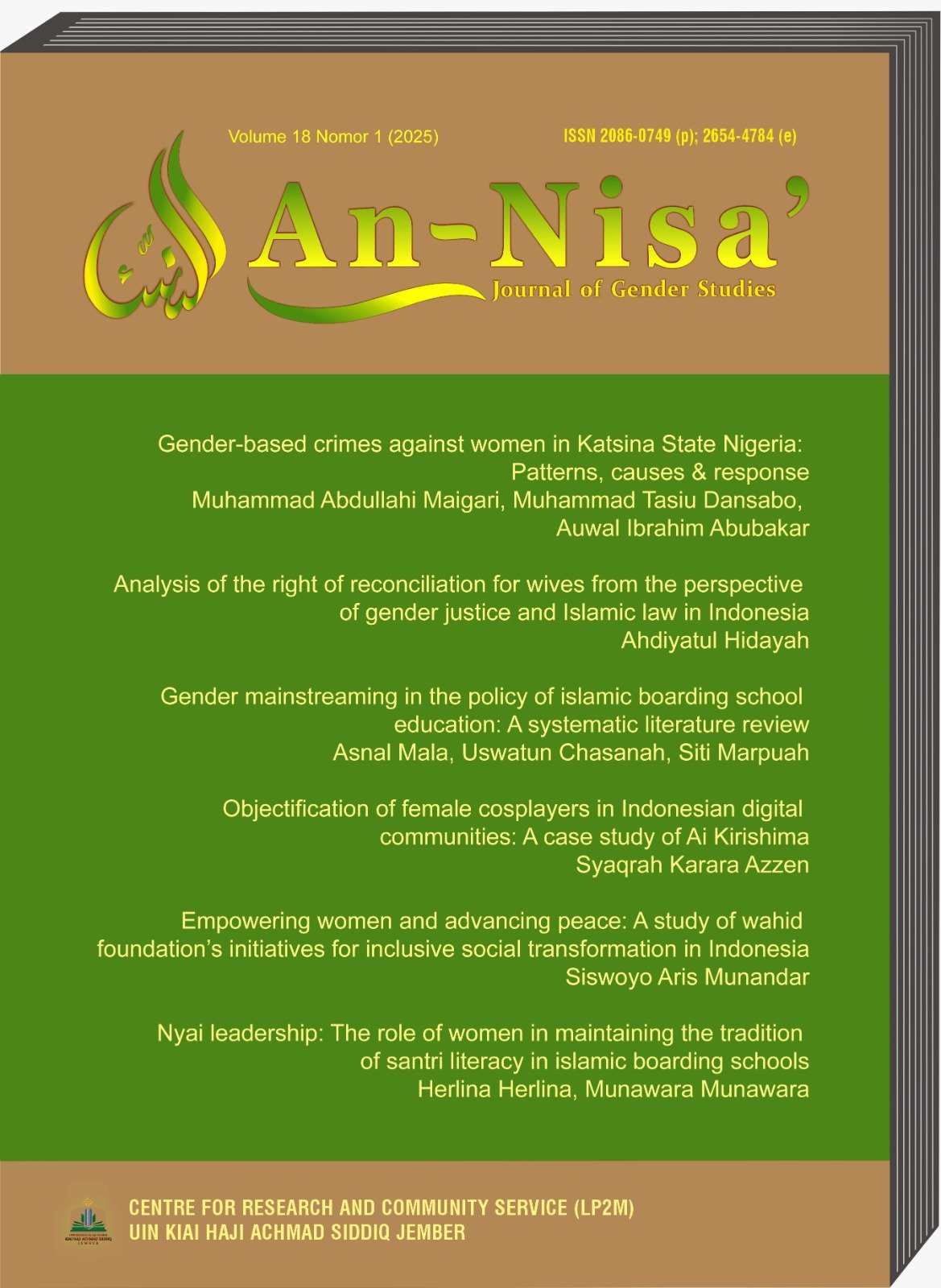
Empowering women and advancing peace: A study of wahid foundation’s initiatives for inclusive social transformation in Indonesia
DOI:
https://doi.org/10.35719/annisa.v18i1.312Keywords:
Wahid Foundation, Women, Empowerment, Peaceful VillageAbstract
The increasing spread of radicalism in rural areas places women as the most affected group; however, they remain excluded from peacebuilding and development processes. This situation reflects a serious irony that may threaten the long-term social sustainability of Indonesia’s future. This study analyzes the Peace Village Program’s response to rural radicalism through women’s empowerment and evaluates its impact on peace declarations and cooperative-based economic institutions. This qualitative case study employed document analysis, participatory observation, and interviews. Data were analyzed thematically using source triangulation and audit trail techniques to ensure validity and adherence to research ethics. The study findings indicate that: (1) the Peace Village Program responds to rural radicalism by empowering women through strengthening tolerance, peace, economic capacity, as well as training and advocacy; (2) the program successfully declares peace villages and empowers women as entrepreneurs; and (3) economic empowerment through the Peace Village Cooperative integrates nine peace indicators, establishes Village-Owned Enterprises (BUMDes), and distributes loans. The study concludes that the Peace Village Program effectively addresses radicalism and empowers women economically, but high participation does not ensure substantive power due to elite dominance and donor dependency. This study contributes to strengthening an integrative approach to village-based peacebuilding and emphasizes the importance of a power perspective, while highlighting the need to enhance women’s capacity, local institutions, and economic sustainability.
References
Abebe, A., & Kegne, M. (2023). The role of microfinance on women’s entrepreneurship development in Western Ethiopia evidence from a structural equation modeling: Non-financial service is the way forward. Cogent Business & Management, 10(3). https://doi.org/10.1080/23311975.2023.2256079
Acim, A., Subagja, D. J., Afiani, D. A., Pratama, G. R., & Al Kautsar, F. (2023). Exploring cultural diversity in Indonesia: Models, responses, and multicultural politics. Candidate: Jurnal Sains Politik, 1(1), 35–54. https://journal.uinsgd.ac.id/index.php/candidate/article/view/33473
Åhlfeldt, E., Isaksson, D., & Winblad, U. (2023). Factors explaining program sustainability: A study of the implementation of a social services program in Sweden. Health & Social Care in the Community, 1458305. https://doi.org/10.1155/2023/1458305
Alasuutari, P. (2009). The rise and relevance of qualitative research. International Journal of Social Research Methodology, 13(2), 139–155. https://doi.org/10.1080/13645570902966056
Anderson, S. (2022). Unbundling female empowerment. Canadian Journal of Economics / Revue canadienne d'économique, 55(4), 1671–1701. https://doi.org/10.1111/caje.12628
Badaruddin, B., Kariono, K., Ermansyah, E., & Sudarwati, L. (2020). Village community empowerment through village owned enterprise based on social capital in North Sumatera. Asia Pacific Journal of Social Work and Development, 31(3), 163–175. https://doi.org/10.1080/02185385.2020.1765855
Barton, G., Vergani, M., & Wahid, Y. (2021). Santri with attitude: Support for terrorism and negative attitudes to non-muslims among Indonesian observant muslims. Behavioral Sciences of Terrorism and Political Aggression, 15(3), 321–335. https://doi.org/10.1080/19434472.2021.1944272
Blomqvist, L., Olivius, E., & Hedström, J. (2021). Care and silence in women’s everyday peacebuilding in Myanmar. Conflict, Security & Development, 21(3), 223–244. https://doi.org/10.1080/14678802.2021.1933031
Bowen, G. A. (2009). Document analysis as a qualitative research method. Qualitative Research Journal, 9(2), 27–40. https://doi.org/10.3316/QRJ0902027
Bräuchler, B. (2022). Creative peacebuilding and resistance in Indonesia. The Asia Pacific Journal of Anthropology, 23(1), 1–19. https://doi.org/10.1080/14442213.2021.2007990
Bryan, E., Alvi, M., Huyer, S., & Ringler, C. (2024). Addressing gender inequalities and strengthening women's agency to create more climate-resilient and sustainable food systems. Global Food Security, 40, 100731. https://doi.org/10.1016/j.gfs.2023.100731
Campbell, S., Greenwood, M., Prior, S., Shearer, T., Walkem, K., Young, S., Bywaters, D., & Walker, K. (2020). Purposive sampling: Complex or simple? research case examples. Journal of research in nursing : JRN, 25(8), 652–661. https://doi.org/10.1177/1744987120927206
Cardenas, M. L., & Olivius, E. (2021). Building peace in the shadow of war: Women-to-women diplomacy as alternative peacebuilding practice in Myanmar. Journal of Intervention and Statebuilding, 15(3), 347–366. https://doi.org/10.1080/17502977.2021.1917254
Carthy, S. L., Doody, C. B., O'Hora, D., & Sarma, K. M. (2018). Protocol: Counter-narratives for the prevention of violent radicalisation: A systematic review of targeted interventions. Campbell systematic reviews, 14(1), 1–23. https://doi.org/10.1002/CL2.202
De la Torre-Castro, M., Fröcklin, S., Börjesson, S., Okupnik, J., & Jiddawi, N. S. (2017). Gender analysis for better coastal management – Increasing our understanding of social-ecological seascapes. Marine Policy, 83, 62–74. https://doi.org/10.1016/j.marpol.2017.05.015
Dushkova, D., & Ivlieva, O. (2024). Empowering communities to act for a change: A review of the community empowerment programs towards sustainability and resilience. Sustainability, 16(19), 8700. https://doi.org/10.3390/su16198700
Wahid Foundation. (2024). Perempuan di Desa sebagai Aktor Perdamaian? Mengapa Tidak? https://khub.id/blog/perempuan-di-desa-sebagai-aktor-perdamaian-mengapa-tidak-38311117
Gangrade, A., Ara, J., & Banerjee, A. (2023). Recent Applied Research In Humanities And Social Science (pp. 1–194). MKSES Publication Lucknow. https://doi.org/10.5281/zenodo.10428694
Gurieva, S. D., Kazantseva, T. V., Mararitsa, L. V., & Gundelakh, O. E. (2022). Social perceptions of gender differences and the subjective significance of the gender inequality issue. Psychology in Russia: State of the Art, 15(2), 65–82. https://doi.org/10.11621/pir.2022.0205
Haley, C., & Marsh, R. (2021). Income generation and empowerment pathways for rural women of Jagusi Parish, Uganda: A double-sided sword. Social Sciences & Humanities Open, 4(1), 100225. https://doi.org/10.1016/j.ssaho.2021.100225
Jeevanasai, S. A., Saole, P., Rath, A. G., Singh, S., Rai, S., & Kumar, M. (2023). Shades & shines of gender equality with respect to sustainable development goals (SDGs): The environmental performance perspectives. Total Environment Research Themes, 8, 100082. https://doi.org/10.1016/j.totert.2023.100082
Joseph, J., Katsos, J. E., & Van Buren, H. J. (2022). Entrepreneurship and peacebuilding: A review and synthesis. Business & Society, 62(2), 322-362. https://doi.org/10.1177/00076503221084638
Jubba, H., Awang, J., Qodir, Z., Hannani, & Pabbajah, M. (2022). The contestation between conservative and moderate Muslims in promoting Islamic moderatism in Indonesia. Cogent Social Sciences, 8(1). https://doi.org/10.1080/23311886.2022.2116162
Kellard, N. M., Makhlouf, Y., Sarkisyan, A., & Vinogradov, D. V. (2024). Women’s empowerment and child mortality. World Development, 183, 106712. https://doi.org/10.1016/j.worlddev.2024.106712
Khan, M., Sulaiman, R., Nazir, O., Khan, S., & Awan, S. (2024). The unseen in the glass ceilings: examining women’s career advancement in higher education institutions through a multi-level institutional lens. Human Resource Development International, 28(5), 799–826. https://doi.org/10.1080/13678868.2024.2342762
Khosa, D., & Abdulkareem, K. (2023). Breaking the cycle: Presenting insights and strategies to overcome violent conflicts hindering social cohesion and progress in South African communities. Global Change, Peace & Security, 35(2), 161–184. https://doi.org/10.1080/14781158.2024.2407827
Krampe, F., Hegazi, F., & VanDeveer, S. D. (2021). Sustaining peace through better resource governance: Three potential mechanisms for environmental peacebuilding. World Development, 144, 105508. https://doi.org/10.1016/j.worlddev.2021.105508
Krause, J., Krause, W., & Bränfors, P. (2018). Women’s participation in peace negotiations and the durability of peace. International Interactions, 44(6), 985–1016. https://doi.org/10.1080/03050629.2018.1492386
Kusuma, J. H., & Susilo, S. (2020). Intercultural and religious sensitivity among young Indonesian interfaith groups. Religions, 11(1), 26. https://doi.org/10.3390/rel11010026
Lafrarchi, N. (2021). Intra- and interreligious dialogue in Flemish (Belgian) secondary education as a tool to prevent radicalisation. Religions, 12(6), 434. https://doi.org/10.3390/rel12060434
Leca, B., & Cruz, L. B. (2021). Enabling critical performativity: The role of institutional context and critical performative work. Organization, 28(6), 903-929. https://doi.org/10.1177/1350508421995759
Lim, W. M. (2024). What is qualitative research? an overview and guidelines. Australasian Marketing Journal, 33(2), 199-229. https://doi.org/10.1177/14413582241264619
Lopera-Arbeláez, I., & Richter, S. (2024). Transformative approaches for peace-centred sustainable development: The role of social and solidarity economy. World Development Perspectives, 34, 100593. https://doi.org/10.1016/j.wdp.2024.100593
Lwamba, E., Shisler, S., Ridlehoover, W., Kupfer, M., Tshabalala, N., Nduku, P., Langer, L., Grant, S., Sonnenfeld, A., Anda, D., Eyers, J., & Snilstveit, B. (2022). Strengthening women's empowerment and gender equality in fragile contexts towards peaceful and inclusive societies: A systematic review and meta-analysis. Campbell systematic reviews, 18(1), e1214. https://doi.org/10.1002/cl2.1214
Merino, M., Tornero-Aguilera, J. F., Rubio-Zarapuz, A., Villanueva-Tobaldo, C. V., Martín-Rodríguez, A., & Clemente-Suárez, V. J. (2024). Body perceptions and psychological well-being: A review of the impact of social media and physical measurements on self-esteem and mental health with a focus on body image satisfaction and its relationship with cultural and gender factors. Healthcare (Basel, Switzerland), 12(14), 1396. https://doi.org/10.3390/healthcare12141396
Muhammad, A., & Hiariej, E. (2021). Deradicalization program in Indonesia radicalizing the radicals. Cogent Social Sciences, 7(1). https://doi.org/10.1080/23311886.2021.1905219
Muluh, G. N., Kimengsi, J. N., & Azibo, N. K. (2019). Challenges and prospects of sustaining donor-funded projects in rural Cameroon. Sustainability, 11(24), 6990. https://doi.org/10.3390/su11246990
Niner, S., Nguyen Thi Phuong Tam, T., Morrison, E., & Iman, M. E. (2023). Feto bele: Contemporary perceptions and expectations of women’s political leadership in Timor-Leste. International Feminist Journal of Politics, 26(1), 100–127. https://doi.org/10.1080/14616742.2023.2203187
Oktari, R. S., Kamaruzzaman, S., Fatimahsyam, F., Sofia, S., & Sari, D. K. (2021). Gender mainstreaming in a disaster-resilient village programme in Aceh province, Indonesia: Towards disaster preparedness enhancement via an equal opportunity policy. International Journal of Disaster Risk Reduction, 52, 101974. https://doi.org/10.1016/j.ijdrr.2020.101974
Palinkas, L. A., Horwitz, S. M., Green, C. A., Wisdom, J. P., Duan, N., & Hoagwood, K. (2015). Purposeful sampling for qualitative data collection and analysis in mixed method implementation research. Administration and policy in mental health, 42(5), 533–544. https://doi.org/10.1007/s10488-013-0528-y
Porter, E. (2013). Rethinking women’s empowerment. Journal of Peacebuilding & Development, 8(1), 1–14. https://doi.org/10.1080/15423166.2013.785657
Puh, K. M. C., Yiadom, A., Johnson, J., Fernando, F., Yazid, H., & Thiemann, C. (2022). Tackling legal impediments to women’s economic empowerment. IMF Working Papers, 2022(037), A001. Retrieved Jun 20, 2025, from https://doi.org/10.5089/9798400203640.001.A001
Rahmawati, A., Wahyuningsih, S. H., & Garad, A. (2023). The effect of financial literacy, training and locus of control on creative economic business performance. Social Sciences & Humanities Open, 8(1), 100721. https://doi.org/10.1016/j.ssaho.2023.100721
Rashid, Y., Rashid, A., Warraich, M. A., Sabir, S. S., & Waseem, A. (2019). Case study method: A step-by-step guide for business researchers. International Journal of Qualitative Methods, 18. https://doi.org/10.1177/1609406919862424
Razia, S., & Abu-Bakar, Ah, S. H. (2023). A call to action: Unpacking the challenges to implementing social sustainability initiatives in a developing country city. Heliyon, 9(8), e19085. https://doi.org/10.1016/j.heliyon.2023.e19085
Rijaal, M. A. K. (2021). Fenomena intoleransi antar umat beragama serta peran sosial media akun instagram jaringan Gusdurian Indonesia dalam menyampaikan pesan toleransi. Syiar | Jurnal Komunikasi Dan Penyiaran Islam, 1(2), 103–132. https://doi.org/10.54150/syiar.v1i2.41
Rrustemi, A., & Kelly, L. M. (2025). Resilience programming for preventing violent extremism in Southeastern Europe: A Local Analysis Of 389 Lifestories. Conflict, Security & Development, 1–22. https://doi.org/10.1080/14678802.2025.2464611
Scheyvens, R., & van der Watt, H. (2021). Tourism, empowerment and sustainable development: A new framework for analysis. Sustainability, 13(22), 12606. https://doi.org/10.3390/su132212606
Shata, A., & Seelig, M. I. (2021). The dragonfly effect: Analysis of the social media women’s empowerment campaign. Journal of Creative Communications, 16(3), 331–346. https://doi.org/10.1177/09732586211036551
Smeer, Z. B., Rosyidah, I., & Mubasyiroh, M. (2024). The potential of women as peacekeepers of religious moderation (Case study of the wahid foundation peace village program in Sidomulyo Village, Batu City). Eduvest - Journal of Universal Studies, 4(9), 8202–8213. https://doi.org/10.59188/eduvest.v4i9.6411
Smeer, Z. bin, Mubasyiroh, & Rosyidah, I. (2022). Strengthening social inclusion and empowerment of women through the wahid foundation Damai Village in Batu City. Budapest International Research and Critics Institute (BIRCI) Journal, 5(1), [Artikel e4474]. https://doi.org/10.33258/birci.v5i1.4474
Susanto, T., Anggara, R., Wahyudin, U., & Supama Wijaya, A. (2025). The role of elders in upholding ‘Guyub Rukun’ In Nglinggi Village, Central Java, Indonesia: Building a peaceful village. Journal of Religion, Spirituality & Aging, 1–26. https://doi.org/10.1080/15528030.2025.2513222
Susanto, T., Sumardjo, Sarwoprasodjo, S., & Kinseng, R. A. (2022). The message of peace from the village: Development of religious harmony from Nglinggi Village. Al-Balagh: Jurnal Dakwah Dan Komunikasi, 7(1), 119–150. https://doi.org/10.22515/albalagh.v7i1.5016
Susilawati, S. (2019). Pemberdayaan perempuan di kampung Damai: Studi pendampingan komunitas oleh wahid foundation di Gemlegan Klaten. Jurnal Pemberdayaan Masyarakat: Media Pemikiran Dan Dakwah Pembangunan, 2(2), 425–446. https://doi.org/10.14421/jpm.2018.022-10
Tabassum, N., & Nayak, B. S. (2021). Gender stereotypes and their impact on women’s career progressions from a managerial perspective. IIM Kozhikode Society & Management Review, 10(2), 192-208. https://doi.org/10.1177/2277975220975513
Tazkianida, R. F. (2025). The contribution of empowered women programs in promoting gender equality for sustainable development goals. Social, Ecology, Economy for Sustainable Development Goals Journal, 2(2), 158–172. https://doi.org/10.61511/seesdgj.v2i2.2025.1116
Thelma, C. C., & Ngulube, L. (2024). Women in leadership: Examining barriers to women’s advancement in leadership positions. Asian Journal of Advanced Research and Reports, 18(6), 273–290. https://doi.org/10.9734/ajarr/2024/v18i6671
Thomson, A., Palmén, R., Reidl, S., Barnard, S., Beranek, S., Dainty, A. R. J., & Hassan, T. M. (2021). Fostering collaborative approaches to gender equality interventions in higher education and research: the case of transnational and multi-institutional communities of practice. Journal of Gender Studies, 31(1), 36–54. https://doi.org/10.1080/09589236.2021.1935804
Torok, A., Gomez-Borquez, C. L., Centeno-Velázquez, E., & Malota, E. (2023). Empowerment through femvertising - evidence from Mexico and Hungary. Feminist Media Studies, 25(1), 87–104. https://doi.org/10.1080/14680777.2023.2268854
UN Women, U. W. (2025). Peace Village: Women-Led Initiative To Promote Peaceful And Resilient Communities In Indonesia. https://asiapacific.unwomen.org/en/countries/indonesia/peace-village
Vujko, A., Karabašević, D., Cvijanović, D., Vukotić, S., Mirčetić, V., & Brzaković, P. (2024). Women’s empowerment in rural tourism as key to sustainable communities’ transformation. Sustainability, 16(23), 10412. https://doi.org/10.3390/su162310412
Wahid, Y. Z., Suaedy, A., Rahman, A. H., Azhari, M. S., Nisa, N., Dja’far, A., & Fata, B. S. (2023). Laporan Kebebasan Beragama/Berkeyakinan dan Toleransi The Wahid Institute Tahun 2010. The WAHID Institute.
Wolff, G. (2024). Promoting gender equality through localized development strategies: Leveraging identification. International Journal of Humanitarian Action, 9(13). https://doi.org/10.1186/s41018-024-00156-7
Downloads
Published
Issue
Section
License
Copyright (c) 2025 Siswoyo Aris Munandar

This work is licensed under a Creative Commons Attribution-NonCommercial 4.0 International License.
 AN-NISA licensed under Creative Commons Attribution-NonCommercial 4.0 International License.