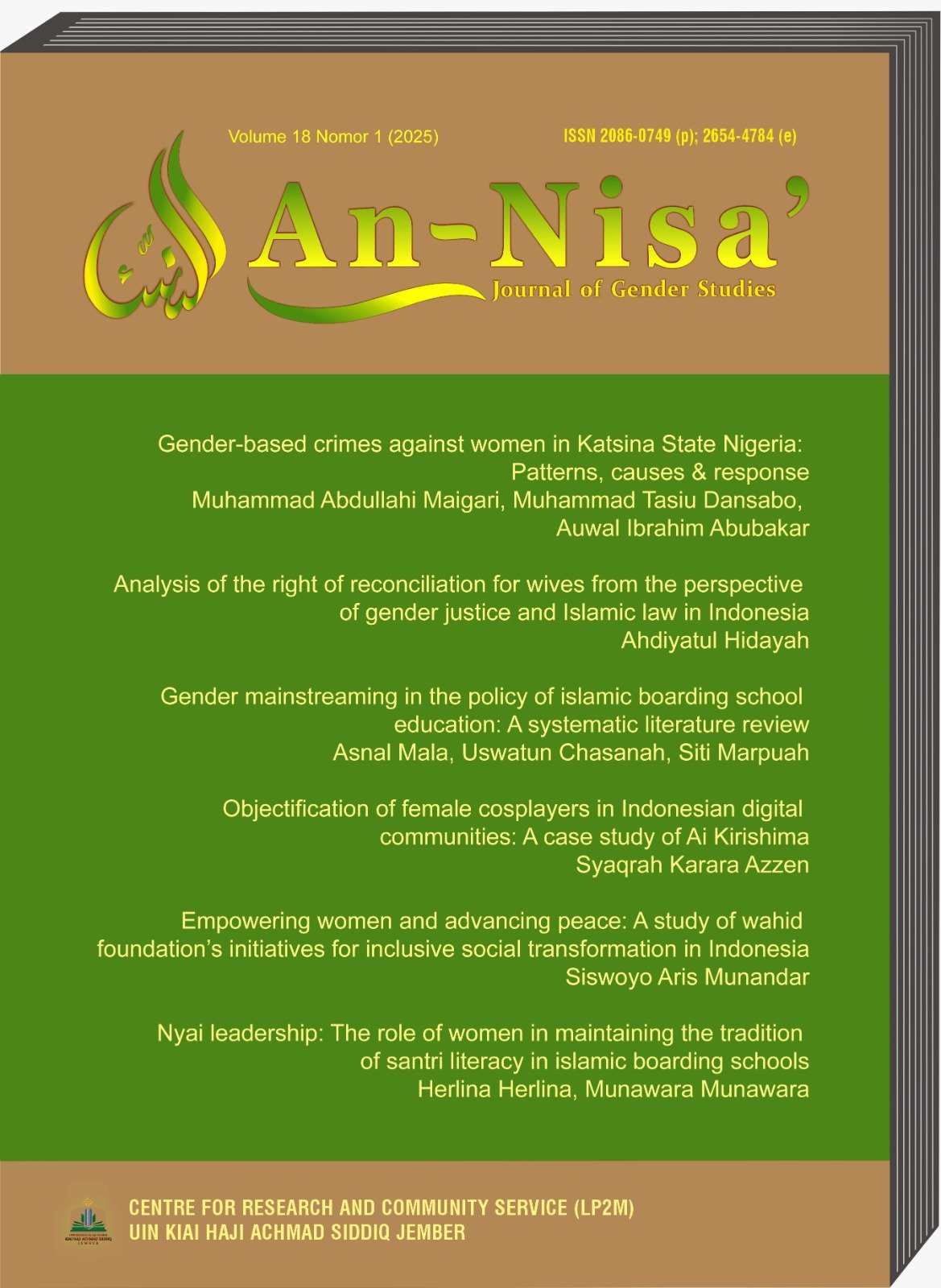
Analysis of the right of reconciliation for wives from the perspective of gender justice and Islamic law in Indonesia
DOI:
https://doi.org/10.35719/annisa.v18i1.302Keywords:
Right of Reference, Justice, Gender, Islamic LawAbstract
In reconciliation practices, wives’ consent is often neglected and interpreted differently across Islamic schools, while gender justice emphasizes equality in marriage. The husband’s unilateral right to reclaim his wife after talaq raj‘i reflects persistent male dominance within marital relations. This study analyzes wives’ reconciliation rights from gender justice and Islamic law in Indonesia, identifying transformation of Islamic family law, Compilation of Islamic Law (KHI) reconstruction, shift from male authority to participatory relational justice. This study employed a qualitative normative-juridical approach using library research. Primary and secondary data sources were analyzed through content analysis and comparative analysis between classical fiqh perspectives, the KHI, and gender justice perspectives. This study finds: (1) Islamic family law transforms toward gender justice via women’s rights, husbands’ ethical duties, khulu’, and equal marital relations; (2) KHI reconstructs reconciliation by requiring wife’s consent, reinforcing her dignity, autonomy, and gender justice; (3) comparing classical law with gender perspectives shows a shift from absolute male authority to participatory reconciliation and relational justice. This study found a transformation of Islamic family law toward gender justice, the reconstruction of the KHI through the requirement of the wife’s consent, and a shift from absolute male authority toward participatory and relational reconciliation. This study contributes to integrating gender justice and maqāṣid al-syarī‘ah within Islamic law, while also encouraging the strengthening of KHI implementation, judicial training, and the inclusion of wife consent clauses in marriage contracts.
References
Abdullah, A. (2023). Honesty is an important value in anti-corruption education for students. Universal Grace Journal, 1(2), 173-183. https://doi.org/10.19109/nurani.v17i1.1348
Adegoke, K. A. (2021). Fiqh al-aqalliyyah and muslim minorities in a non-muslim community. Jurnal Syariah, 29(1), 1–20. https://doi.org/10.22452/js.vol29no1.1
Afian, T., & Saputra, R. D. A. (2021). Innovation of elementary school library facilities in increasing reading interest. Visionary Journal: Research and Development in the Field of Educational Administration, 9(1), 6-12. DOI: https://doi.org/10.33394/vis.v6i1.4083
Aisya, A., Helniyani, H., Wulandari, P., & Noviani, D. (2024). The concept of back to ex husband in an Islamic perspective. Al-Tarbiyah: Journal of Islamic Education, 2(3), 273-293. DOI: https://doi.org/10.59059/al-tarbiyah.v2i3.1267
Al-As' ary, M. K. H. (2016). The Perempuan Authority Rejects The Reference In The Gender And Maslahah Approach. PALASTREN: Journal of Gender Studies, 8(1), 103-124. http://dx.doi.org/10.21043/palastren.v8i1.936
Albert, R., Landau, D., Faraguna, P., & Drugda, Š. (2018). The I·CONnect-clough center 2017 global review of constitutional law. Clough Center for the Study of Constitutional Democracy. https://doi.org/10.2139/ssrn.3215613
Atmadianti, S., & Rizal, M. (2024). Marriage annulment application due to lies and fraud: A case study of decree number 3572/Pdt.G/2023/PA.Ckr. Al-Ishlah: Jurnal Ilmiah Hukum, 27(2), 374-390. https://doi.org/10.56087/aijih.v27i2.510
Bariah, O., & Ferianto, F. (2024). Legal implications of marriage during the ’iddah period: Analytical study of the opinions of fiqh scholars. International Journal Ihya’ ’Ulum Al-Din, 26(1), 10–22. https://doi.org/10.21580/ihya.26.1.20519
Benuf, K., & Azhar, M. (2020). Legal research methodology as an instrument to unravel contemporary legal problems. Gema Keadilan, 7(1), 20-33. DOI: https://doi.org/10.14710/gk.2020.7504
Cameron, L. (2023). Gender equality and development: Indonesia in a global context. Bulletin of Indonesian Economic Studies, 59(2), 179–207. https://doi.org/10.1080/00074918.2023.2229476
Campbell, A. (2005). How have policy approaches to polygamy responded to women's experiences and rights? An international, comparative analysis: Final report for Status of Women Canada. https://doi.org/10.2139/ssrn.1360230
Carback, J. (2016). On sharia in American family law: Confronting The Dangers Of Legal Pluralism. International Journal of the Jurisprudence of the Family. https://doi.org/10.2139/ssrn.3015028
Chappell, L., Halliday, L., & Potts, H. (2024). Sex, gender and human rights: Essential components of inclusive medical research. Australian Journal of Human Rights, 30(1), 115–122. https://doi.org/10.1080/1323238X.2024.2413261
Cheong, H., Lyons, A., Houghton, R., & Majumdar, A. (2023). Secondary qualitative research methodology using online data within the context of social sciences. International Journal of Qualitative Methods, 22. https://doi.org/10.1177/16094069231180160
Cislaghi, B., & Heise, L. (2020). Gender norms and social norms: Differences, similarities and why they matter in prevention science. Sociology of health & illness, 42(2), 407–422. https://doi.org/10.1111/1467-9566.13008
Cohen, D., Jasper, K., Zhao, A., Moalla, K. T., Nwuke, K., Nesamoney, S., & Darmstadt, G. L. (2024). Gender norms in a context of legal pluralism: Impacts on the health of women and girls in Ethiopia. Global Public Health, 19(1). https://doi.org/10.1080/17441692.2024.2326016
Cullati, S., Bochatay, N., Maître, F., Laroche, T., Muller-Juge, V., Blondon, K. S., Junod Perron, N., Bajwa, N. M., Viet Vu, N., Kim, S., Savoldelli, G. L., Hudelson, P., Chopard, P., & Nendaz, M. R. (2019). When team conflicts threaten quality of care: A study of health care professionals' experiences and perceptions. Mayo Clinic proceedings. Innovations, quality & outcomes, 3(1), 43–51. https://doi.org/10.1016/j.mayocpiqo.2018.11.003
Elo, S., Kääriäinen, M., Kanste, O., Pölkki, T., Utriainen, K., & Kyngäs, H. (2014). Qualitative content analysis: A focus on trustworthiness. SAGE Open, 4(1). https://doi.org/10.1177/2158244014522633
Farkhani, F., Elviandri, E., Khudzaifah, D., & Absori, A., & Zuhri, M. (2022). Converging Islamic and religious norms in Indonesia’s state life plurality. Indonesian Journal of Islam and Muslim Societies. 12. 421-446. https://doi.org/10.18326/ijims.v12i2.421-446
Fattah, A. (2019). Rethinking jacques derrida’s deconstruction and its relevance to the study of Islam. Ulumuna, 23(1), 113-134. https://doi.org/10.20414/ujis.v23i1.349
Gander, F., Uhlich, M., Traut, A. C., Saameli, M. A., Bühler, J. L., Weidmann, R., & Grob, A. (2024). The role of relationship beliefs in predicting levels and changes of relationship satisfaction. European Journal of Personality, 39(1), 105-121. https://doi.org/10.1177/08902070241240029
George, M. (2008). The Elements of Library Research: What Every Student Needs to Know. Princeton: Princeton University Press. https://doi.org/10.1515/9781400830411
Glázer-Kniesz, A., & Makay, Z. (2024). Gender roles and the division of household labour by family type in three different welfare states. Demográfia, 67(1), 43–93. https://doi.org/10.21543/DEM.67.1.2
Grossbard-Shechtman, S., & Lemennicier, B. (1999). Marriage contracts and the law-and-economics of marriage: An Austrian perspective. The Journal of Socio-Economics, 28(6), 665–690. https://doi.org/10.1016/S1053-5357(99)00059-1
Güney, N. (2024). Maqāsid al-sharī‘a in Islamic finance: A critical analysis of modern discourses. Religions, 15(1), 114. https://doi.org/10.3390/rel15010114
Guterres, V. M. L., Marhaeni, A. A. I. N., Dewi, M. H. U., & Mustika, M. D. S. (2024). The tradition of dowry and gender equality issues: A literature review. Journal of World Science, 3(9), 1185–1197. https://doi.org/10.58344/jws.v3i9.721
Halim, P., & Amalia, N. (2024). Reconstructing Islamic inheritance distribution through a gender justice approach. Shautuna: Jurnal Ilmiah Mahasiswa Perbandingan Mazhab, 5(3), 835-848. https://doi.org/10.24252/shautuna.v5i3.48448
Hermanto, A. (2022). Maintaining the values of reciprocity in carrying out the rights and obligations of husband and wife from the perspective of fiqh mubadalah. Al-Mawarid Journal of Sharia and Law (JSYH), 4(1), 43-56. https://doi.org/10.20885/mawarid.vol4.iss1.art3
Hidayah, N. P., & Komariah, K. (2024). The legal status of marital joint property sourced from the wife. KnE Social Sciences, 9(1), 701–708. https://doi.org/10.18502/kss.v8i21.14786
Kraus, S., Jones, P., Kailer, N., Weinmann, A., Chaparro-Banegas, N., & Roig-Tierno, N. (2021). Digital transformation: An overview of the current state of the art of research. SAGE Open, 11(3). https://doi.org/10.1177/21582440211047576
Langaji, A., Hafid, S. A., Bakti, A. F., & Haris, A. G. (2024). Islamic feminists’ rejection of the textual understanding of misogynistic hadiths for the advancement of gender justice in Makassar, Indonesia. Samarah: Jurnal Hukum Keluarga dan Hukum Islam, 8(1), 196–215. https://doi.org/10.22373/sjhk.v8i1.19856
Lee, Y., Bradford, B., & Posch, K. (2024). The effectiveness of big data-driven predictive policing: Systematic review. Justice Evaluation Journal, 7(2), 127–160. https://doi.org/10.1080/24751979.2024.2371781
Luft, J. A., Jeong, S., Idsardi, R., & Gardner, G. (2022). Literature reviews, theoretical frameworks, and conceptual frameworks: An introduction for new biology education researchers. CBE life sciences education, 21(3), rm33. https://doi.org/10.1187/cbe.21-05-0134
Lwamba, E., Shisler, S., Ridlehoover, W., Kupfer, M., Tshabalala, N., Nduku, P., Langer, L., Grant, S., Sonnenfeld, A., Anda, D., Eyers, J., & Snilstveit, B. (2022). Strengthening women's empowerment and gender equality in fragile contexts towards peaceful and inclusive societies: A systematic review and meta-analysis. Campbell systematic reviews, 18(1), e1214. https://doi.org/10.1002/cl2.1214
Makmun, M., & Rohman, K. (2017). The thoughts of Imam Malik and Imam Shafi'i on witnesses in reference. Journal of Islamic Family Law, 2(1), 21-38. https://journal.unipdu.ac.id/index.php/jhki/article/view/943
Malayudha, A. G., Sari, W., & Asiandu, A. P. (2023). Indonesian inheritance system based on Islamic law, civil code, matrilineal customs, and gender equality perspectives. SANGKéP: Jurnal Kajian Sosial Keagamaan, 6(1), 55–73. https://doi.org/10.20414/sangkep.v6i1.6286
Maloko, M. T., Chotban, S., Fuady, M. I. N., & Hasdiwanti. (2024). Analyzing the prohibition of interfaith marriage in Indonesia: Legal, Religious, And Human Rights Perspectives. Cogent Social Sciences, 10(1). https://doi.org/10.1080/23311886.2024.2308174
Maula, B. S., & Vivi, A. (2022). Justice negotiations for women: Divorce cases due to domestic violence in religious courts. Jurnal Hukum Islam, 20(1), 155–180. https://doi.org/10.28918/jhi.v20i1.6024
Maulida, F., & Busyro, B. (2018). Iddah maintenance due to talak bain in the perspective of gender justice (analysis of Indonesian marriage law). Al Hurriyah: Journal of Islamic Law, 3(2), 113-130. https://doi.org/10.30983/alhurriyah.v3i2.720
Mera, N., Marzuki, M., Taufan, M. B., Sapruddin, S., & Cahyani, A. I. (2024). Child custody rights for mothers of different religions: Maqāṣid al-sharī'ah perspective on Islamic family law in Indonesia. Samarah: Jurnal Hukum Keluarga dan Hukum Islam. 8. 1645. https://doi.org/10.22373/sjhk.v8i3.23809
Muhibbulloh, M. Z., Khoiroh, D. N., & Darojad, A. R. U. (2021). The rights of wives in referring according to the fiqh of the four schools and the compilation of Islamic Law (Maqasid Al-Shari'ah Perspective). The Indonesian Journal of Islamic Law and Civil Law, 2(2), 185-205. https://doi.org/10.51675/jaksya.v2i2.168
Mun'im, A., & Suaidi, S. (2024). Revisioning official Islam in Indonesia: The Role of Women Ulama Congress in Reproducing Female Authority in Islamic Law. Ahkam: Jurnal Ilmu Syariah, 136. https://doi.org/10.15408/ajis.v24i1.34744
Nely, R. (2024). Procedures for marriage, divorce and referral according to the compilation of Islamic law. Juripol (Journal of Ganesha Polytechnic Institution Medan), 7(2), 42-53. https://jurnal.polgan.ac.id/index.php/juripol/article/view/14033
Patoari, M. (2019). The rights of women in Islam and some misconceptions: An analysis from Bangladesh perspective. Beijing Law Review, 10(5), 1211–1224. https://doi.org/10.4236/blr.2019.105065
Pomahiya, S., Kasim, N. M., & Bakung, D. A. (2022). Legal consequences of marriage during iddah period based on compilation Islamic law. Estudiante Law Journal. 4. 708-719. https://doi.org/10.33756/eslaj.v4i2.18848
Ramadhita, R., Ali, M., & Syabbul, B. (2023). Gender inequality and judicial discretion in muslims divorce of Indonesia. Cogent Social Sciences, 9(1). https://doi.org/10.1080/23311886.2023.2206347
Rohmah, N. N., Mahsun, M., & Hidayat, M. S. (2025). Rethinking marital sexual refusal in Islam: Faqihuddin Abdul Kodir’s Perspective. FUQAHA Journal of Islamic Law, 1(1), 23-40. https://fuqaha.ibnusantara.com/index.php/fqh/article/view/7
Rufaida, A. (2019). The right of the wife to refuse to refer to the perspective of Islam and gender. Yinyang: Journal of Islamic Studies https://doi.org/10.24090/yinyang.v14i2.2944
Salim, A., & Wulandari, S. (2023). Comparison of the rights and obligations of husband and wife in the compilation of islamic law and Indonesian Civil Law. Indonesian Journal of Islamic Law, 6(1), 52-66. https://doi.org/10.35719/ijil.v6i1.2015
Santoso, L., Amaliyah, A., & Huda, M. (2023). Refusal of polygamy permit in religious court decision: Criticism of gender justice against judge’s legal reasoning. Al-Risalah: Forum Kajian Hukum Dan Sosial Kemasyarakatan, 23(2), 160–173. https://doi.org/10.30631/alrisalah.v23i2.1472
Scott, S. B., Rhoades, G. K., Stanley, S. M., Allen, E. S., & Markman, H. J. (2013). Reasons for divorce and recollections of premarital intervention: Implications for improving relationship education. Couple and Family Psychology: Research and Practice, 2(2), 131–145. https://doi.org/10.1037/a0032025
Sindin, X. (2017). Secondary data. In the sage encyclopedia of communication research methods (Vol. 4, pp. 1578-1579). SAGE Publications, Inc, https://doi.org/10.4135/9781483381411.n557
Snyder, H. (2019). Literature review as a research methodology: An overview and guidelines. Journal of Business Research, 104, 333–339. https://doi.org/10.1016/j.jbusres.2019.07.039
Sugiarto, Y. (2022). Bible principles regarding marriage, divorce and remarriage. Excelsis Deo: Journal of Theology, Missology, and Education, 6(1), 40-48. https://doi.org/10.51730/ed.v6i1.72
Suryantoro, D. D., & Rofiq, A. (2022). The right of an ex-wife to refuse to refer to an ex-husband according to a compilation of Islamic law. AHSANA MEDIA: Journal of Islamic Thought, Education and Research, 8(1), 24-34. https://doi.org/10.31102/ahsanamedia.8.1.2022.24-34
Sutton, J., & Austin, Z. (2015). Qualitative research: Data collection, analysis, and management. The Canadian Journal Of Hospital Pharmacy, 68(3), 226–231. https://doi.org/10.4212/cjhp.v68i3.1456
Tchoukou, J. A. (2024). The social construction of childhood: Is a minimum age of marriage attainable in plural societies? International Journal of Law in Context, 20(4), 549–567. https://doi.org/10.1017/S1744552324000181
Thoyib, M., & Huda, M. C. (2022). The dynamics of Islamic family law: From pre-prophetic to prophetic. Bidayah: Studies of Islamic Sciences, 132-148. https://doi.org/10.47498/bidayah.v13i1.1054
Wickham, R. J. (2019). Secondary analysis research. Journal of the advanced practitioner in oncology, 10(4), 395–400. https://doi.org/10.6004/jadpro.2019.10.4.7
Yotenka, R., Dini, S. K., Fauzan, A., & Ahdika, A. (2022). Exploring the relationship between hadith narrators in book of Bukhari through SPADE algorithm. MethodsX, 9, 101850. https://doi.org/10.1016/j.mex.2022.101850
Downloads
Published
Issue
Section
License
Copyright (c) 2025 Ahdiyatul Hidayah

This work is licensed under a Creative Commons Attribution-NonCommercial 4.0 International License.
 AN-NISA licensed under Creative Commons Attribution-NonCommercial 4.0 International License.